EU fuel prices up 31.4% year on year. Inflation is fuelling up at our expense again…
EU fuel prices up 31.4% year on year. Inflation is fuelling up at our expense again…
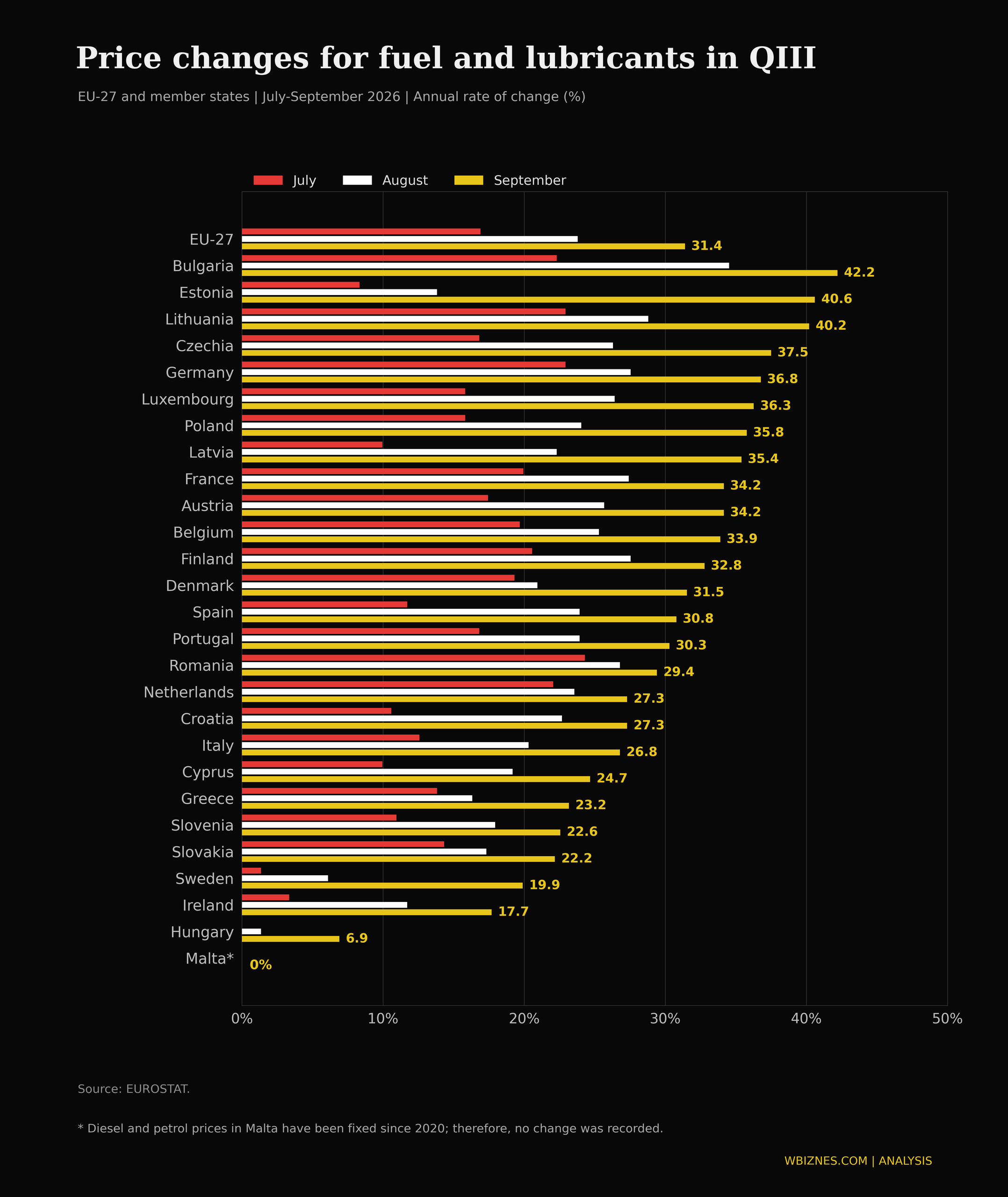
Those optimists who forecasted inflation to cool down quickly and counted on interest-rates cuts any time soon may want to put the celebration confetti away for some time. Although the Monetary Policy Council has left rates unchanged this month, rising fuel prices are a reminder that inflation still has plenty of fuel in the tank. In September, the EU’s fuel and lubricants prices climbed up by 31.4% year to year and it was the highest increase in third quarter.
The sharpest fuel price increases were recorded in Bulgaria (+42.2%), Estonia (+40.6%) and Lithuania (+40.2%) – the only three countries where they exceeded 40% year on year. In 12 other countries, increases exceeded 30%, ranging from 30.3% in Portugal to 37.5% in Czechia. The smallest increases were noted in Hungary (+6.9%), Ireland (+17.7%) and Sweden (+19.9%).
ESTIMATED SEPTEMBER FUEL PRICE RANK
Percentage increases above do not necessarily reflect current price levels. Fuel is not necessarily the most expensive in the countries where prices rose the most in Q3. That is why, alongside price changes, we also checked the average prices of petrol and diesel in September:
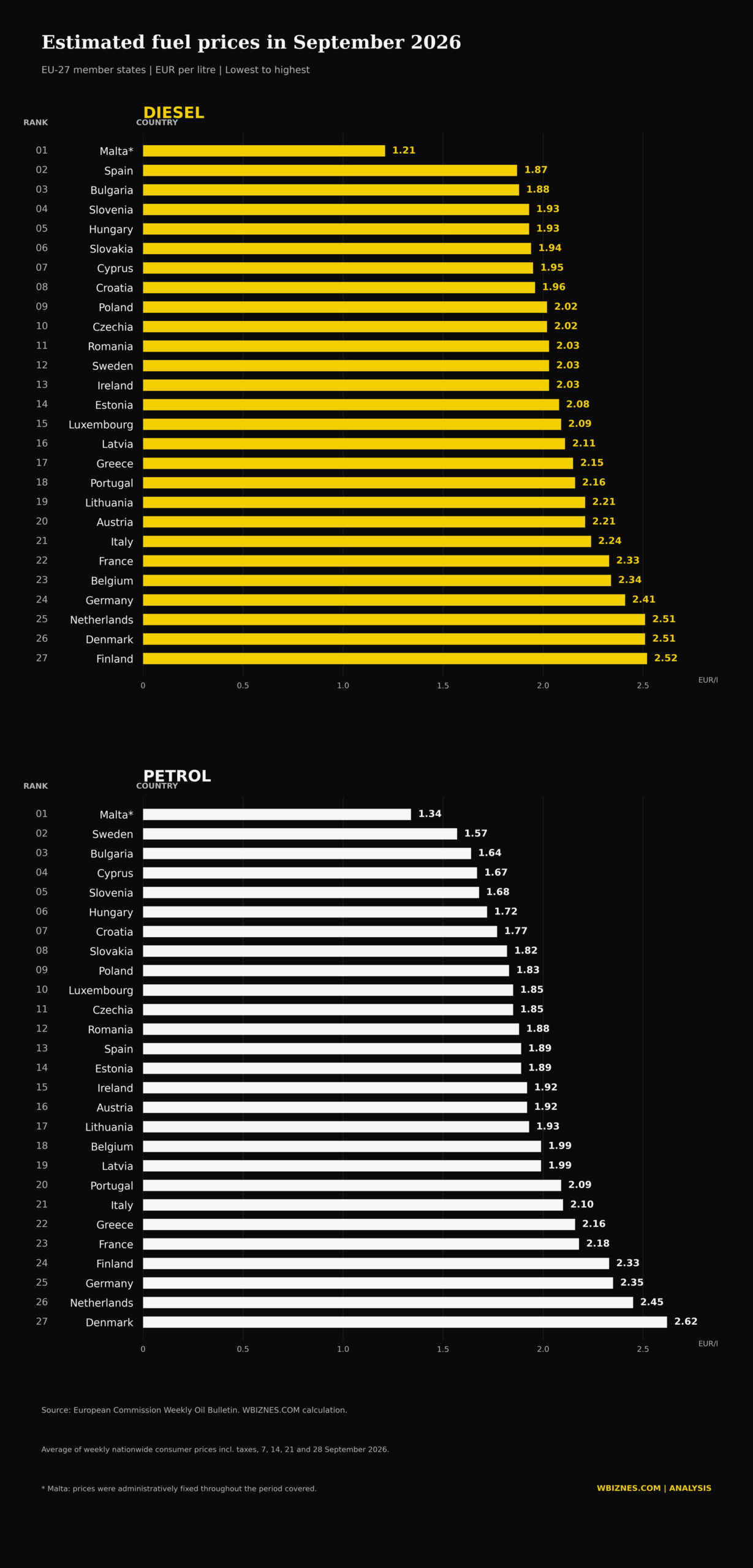
A sharp, analytical eye will spot a paradox here, which we’ll discuss below.
SMALL BUT MIGHTY? WHAT ABOUT EU UNITY?
In this case – yes, indeed. Malta – the EU’s smallest country by both area (316 km²) and population (588 254 residents at the end of 2025) – has kept petrol and diesel pump prices unchanged since June 2020 and has the lowest prices among Member States.
The government has mastered the use of hedging instruments and established a system of state-funded subsidies. Some will say Malta can afford this because it has no land neighbours whose motorists could drive across the border to fill up with cheaper fuel at the Maltese taxpayer’s expense. That is an argument worth considering. But perhaps that is precisely why we should discuss a common European mechanism for stabilising fuel prices, inspired by the Maltese model and focusing on their price level.
If the EU can collectively decide what Europeans should drive, perhaps it can also do something about how much it costs them to get to work?
Especially that the negotiating position of the Union as a whole would be considerably much better than that of each country individually. At the moment, it feels a little like watching a football match in which every player is trying to score in their own individual goal.
The truth is that no European country can compete with the US, China or Russia on its own.
Together, however, they can achieve much more. They just need to focus on their priorities. Abandon/suspend strategic projects concerning caps attached to bottles or the vision of a green Europe, which will probably remain nothing more than a utopian dream forever, and focus on what really matters.
FUEL AT PLN 3.56 (€0.82) A LITRE? JUST ACROSS THE BORDER OF PODLASIE (a voivodeship in north-eastern Poland).
Interestingly, many residents of Poland’s Podlaskie region fill up petrol at significantly lower prices than the Polish residents of other regions or even their Maltese friends, who enjoy the lowest fuel prices in the EU. Thanks to visa-free entry into Belarus, they can substantially reduce their fuel bills.
Collectively, the EU could probably negotiate much better prices – not necessarily with a Belarusian supplier. Although someone might rightly point out that in some parts of Europe, we fill up with fuel of exactly the same origin, only at several times the price.
WHO GAINS WHEN EVERYONE LOSES?
It turns out that high fuel prices, and even inflation, have their supporters. This is not just about governments, but also companies that cleverly use catchy headlines to justify further price increases. Even when fuel accounts for only a small share of their products’ total cost, and its actual impact on the final price is far smaller than the size of the increase suggested.
Given current market conditions, everyone should have an interest in stabilising the fuel market. Otherwise, we risk another wave of price increases and rising inflation in the coming months, while some businesses are already struggling to remain competitive.
And everyone benefiting from the current situation should ask themselves:
What happens when another company in Europe – my supplier, customer or partner, a taxpayer – turns off the lights?
Follow us on social media and stay up to date with WBIZNES.COM.


You May Also Like
Is this a turning point in working with construction and installation service providers?
India’s Economy – A Market European Companies Should Not Ignore