

India’s Economy – A Market European Companies Should Not Ignore
Today, 15 August, Poland celebrates Polish Armed Forces Day, commemorating the victory in the Battle of Warsaw in 1920. We wish all serving and former members of the Polish Armed Forces good health, safety, prosperity and a lasting sense of fulfilment from their service to Poland. Thank you for your service.
On the same day, India celebrates its Independence Day. On this occasion, we wish the people of India peace, prosperity and continued development.
As WBIZNES.COM focuses primarily on business and the economy, we are taking this opportunity to examine a country that could become one of the world’s fastest-growing markets in the years ahead.
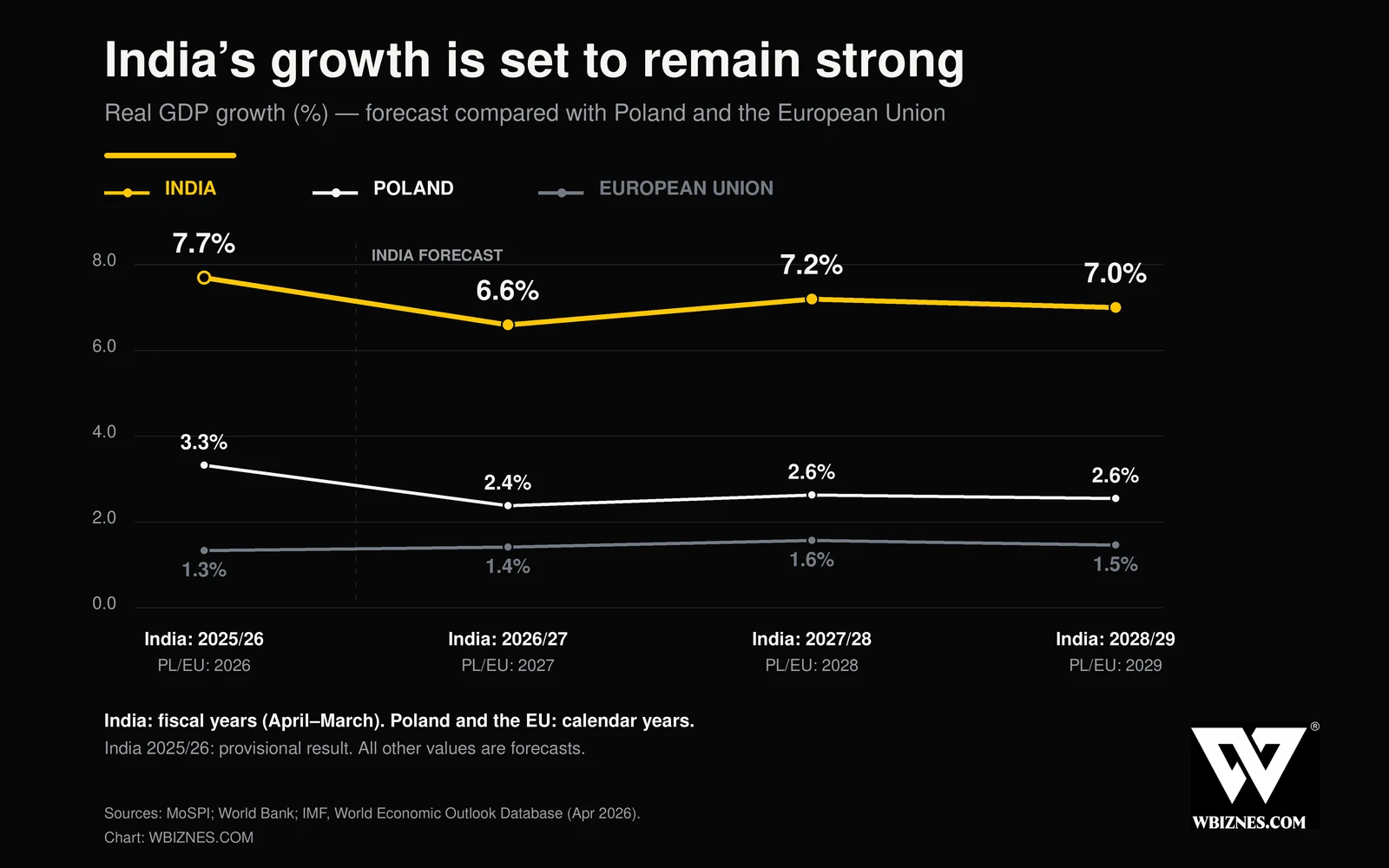
India’s economic momentum is best illustrated by comparing real GDP growth rates. In the 2025/26 fiscal year, the Indian economy grew by 7.7%. By comparison, the real GDP of the European Union increased by 1.4% in 2025, while the Polish economy grew by 3.6% over the same period.
This means that India’s growth rate was more than five times higher than that of the European Union as a whole and more than twice as high as Poland’s. It should be noted that India’s fiscal year runs from April to March, meaning that the periods being compared do not align exactly. Nevertheless, the difference is sufficiently large to illustrate the scale of India’s economic momentum.
The forecasts are equally promising:
This brings us to a frequently repeated argument: European companies cannot compete on price with businesses from Asia. There is considerable truth in this claim—provided that competition is reduced solely to production costs. It does not, however, mean that there is no place for European businesses in the Indian market. European companies do not have to win by offering the lowest price. Their competitive strengths may lie in technology, quality, safety, automation and specialised solutions that India’s rapidly expanding economy continues to source from abroad.
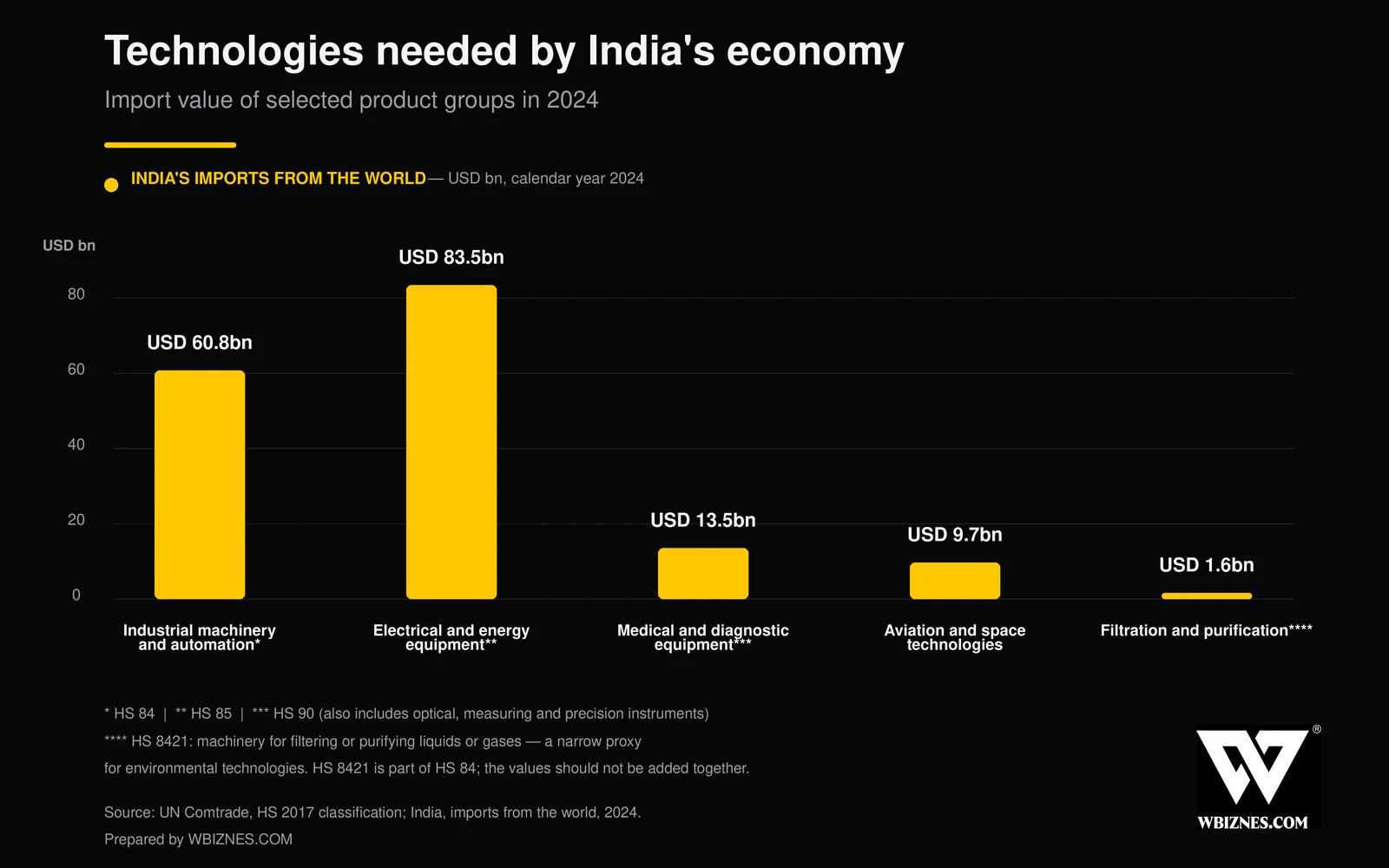
The scale of this demand is reflected in import data. In 2024, India imported electrical and electronic equipment classified under HS 85 worth USD 83.5 billion. Imports of machinery and mechanical equipment under HS 84 reached USD 60.8 billion. Optical, measuring, medical and diagnostic equipment accounted for USD 13.5 billion, while imports of aircraft, space technologies and related parts reached USD 9.7 billion. Together, these categories were worth approximately USD 167.5 billion.
India is not an easy market to enter. European companies must navigate complex regulations and restrictions on market access. Nevertheless, the scale of the economy and its demand for foreign technologies make India a market worth considering.
These barriers have not deterred European suppliers. The fact that large-scale sales are possible is demonstrated by existing trade flows. In 2024, the European Union exported goods worth EUR 48.8 billion to India. The leading categories included machinery and electrical equipment, as well as transport equipment. Given the rapid development of the Indian economy, the potential for further growth in European sales remains significant.
The good news is that negotiations on a free trade agreement between the European Union and India were concluded on 27 January 2026. As of 15 August 2026, the agreement has not yet been formally signed, and there is no confirmed date for its entry into force. Once it starts to apply, India is expected to eliminate or reduce tariffs on 96.6% of goods imported from EU. This will completely change the outlook.
Easier access for exports, however, is not the only argument. India’s domestic market remains even more important.
The Domestic Market – The Main Reason India Should Not Be Ignored
A free trade agreement may make it easier for European companies to access India, but the most important argument remains the domestic market itself. The country has a population of approximately 1.45 billion, and as its economy grows, consumer incomes and spending are also increasing. The scale of this market is well illustrated by the New Delhi urban agglomeration, which, according to UN estimates, had approximately 30.2 million residents in 2025 (local residents, however, believe that this estimate may be highly understated). By comparison, Poland’s entire population amounted to approximately 37.3 million at the end of 2025.
European companies have already recognised this potential. According to Schneider Electric, India is the Group’s third-largest market, and the company operates 31 factories in the country. India is also one of Schneider Electric’s four global hubs. Airbus and Tata Advanced Systems have opened a C295 aircraft assembly line in Vadodara. L’Oréal operates two factories and research and development centres in India, while IKEA is expanding its local retail operations and working with approximately 65 Indian suppliers.
These examples demonstrate how a presence in India can serve two objectives simultaneously. Local production and cooperation with Indian partners can help optimise production and logistics costs, while also making it easier to adapt products and services to customer needs and build a lasting position in a rapidly expanding market.
India should therefore not be viewed solely as an export destination. For some European companies, the right approach may be to combine exports with local distribution, servicing and cooperation with Indian businesses, followed in the longer term by joint manufacturing or research and development activities serving the domestic market.
The greatest potential lies in an equal partnership based on mutual respect, trade, the exchange of experience and shared development. India is not only a vast market but also a dynamic and innovative country with strong capabilities and an ambitious vision for the future. On the day India celebrates its Independence Day, it is worth emphasising that joint ventures between Indian and European companies can create long-lasting advantages for both sides.
हमारे सभी भारतीय मित्रों को स्वतंत्रता दिवस की हार्दिक शुभकामनाएँ।
For more business analysis, economic data and insights into global markets, visit WBIZNES.COM and follow us on social media.


You May Also Like

Layoffs Hidden from the Statistics. Why Isn’t Unemployment Rising Despite a Wave of Alarming Reports?

Where does your steel really come from? The EU will trace which furnace it was melted in.