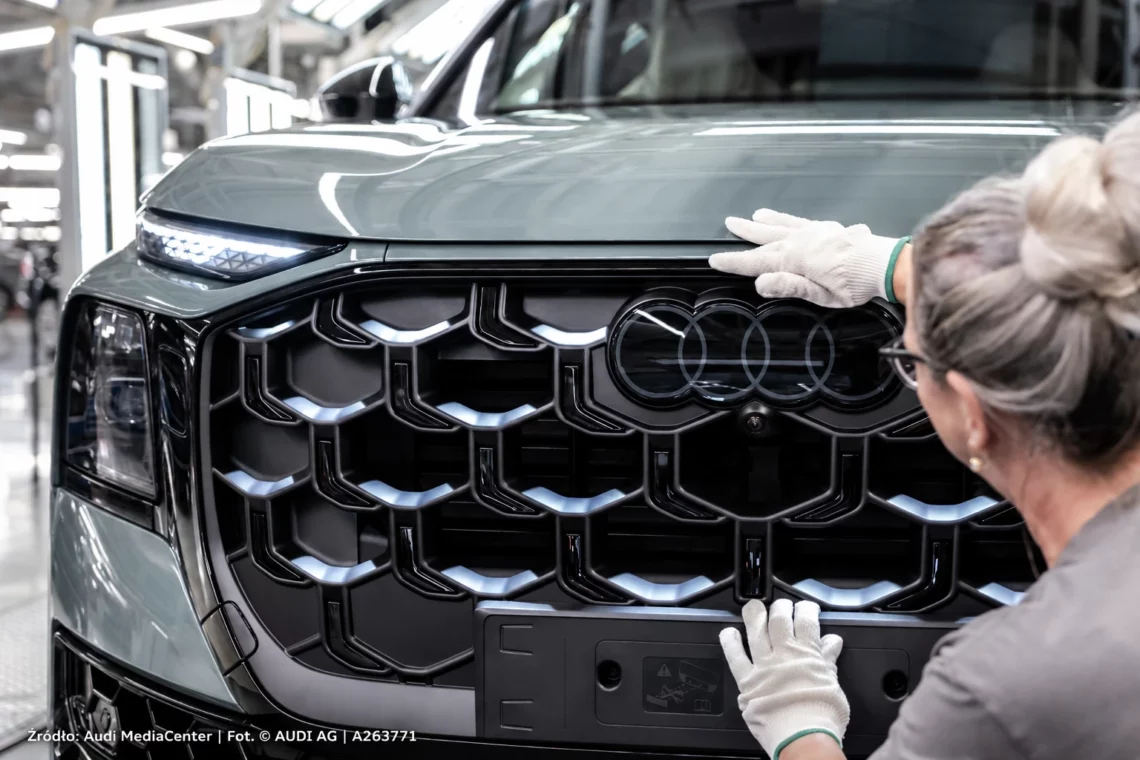
AUDI Q9. The largest and the most luxurious SUV in the brand’s history
AUDI Q9. The largest and the most luxurious SUV in the brand’s history
Despite significant restructuring plans affecting many employees across Europe, ambitious commitments to decarbonisation, fierce competition from Asia and uncertainty surrounding US tariffs policy, Audi has done a strategic split by bringing to the market the completely new Q9 model – the largest and the most luxurious SUV in the brand’s history.
A well-considered strategy or a complete misunderstanding of the current market?
AUDI Q9
With an impressive 5.31 metres of length and 3.14 metres of axial distance, the vehicle offers six or seven extremely comfortable seats and an interior designed to deliver a top business-class experience. Electric individual seats in the second row, a panoramic roof covering more than 1.5 m², adaptive air suspension and advanced digital systems are just some of the features that highlight the luxurious character of the Audi Q9. European versions are empowered by 3.0-litre V6 engines producing 245 and 299 hp, supported by mild-hybrid technology and paired with quattro all-wheel drive. Despite its outstanding dimensions and luxurious equipment, Audi has decided to encourage potential buyers with a pretty reasonable pricing policy. At the Polish premiere in October 2026, the price list started from just as low as PLN 516 600.
All the above will undoubtedly enable Audi to increase its share of the tort in the prestigious large premium SUV segment which currently includes models like BMW X7 and Mercedes-Benz GLS.
PREMIUM CLIENT
Taking into consideration customer-behaviour perspective, Audi’s decision to launch the Q9 model appears like a well-considered strategic move in the current market situation. Focusing on the most prestigious segment of the market gives the manufacturer an opportunity to achieve significantly higher margins, improving sales profitability and increasing single transaction value. In view of lower sales in the remaining segments, it seems like a perfect way to stabilise/halt the decline in financial performance and strengthen Audi’s market position.
Luxury-car buyers do not base their purchasing decisions solely on a price tag, technical specification or equipment. Brand recognition and the social status associated with it also play a significant role here.
This is particularly important in the face of growing competition from Chinese manufacturers, whose vehicles have caught up with their European counterparts in terms of quality and equipment while offering considerably more attractive prices.
Yet a reputational advantage built over decades cannot be recreated in just a few years.
In Europe, however, even the best Chinese car is still somehow not perceived as a symbol of success regardless of its quality and features. And in this segment, a car is expected not only to meet its owner’s expectations but also to make the right impression on others. Unlike any other option, prestige is not something you can simply add in the configurator.
There are more challenges ahead. Lack or limited network of authorised service centres, spare-parts availability and uncertainty surrounding the residual value of vehicles from Asia are just a few to address.
And premium clients are not just buying a brand on the bonnet. They are also buying peace of mind, predictable service in case of trouble and freedom from uncertainty on the road. After all, it is ridiculous to expect someone spending half a million zlotys on a car to become a beta tester for a still-developing after-sales network.
GEOPOLITICAL SPLIT
Audi makes no secret of the fact that the Q9 was developed primarily with the US market in mind, where full-size SUVs are in strong demand. Interestingly, however, production of the new flagship has been located in Bratislava, where Volkswagen Group has manufactured the Q7 and Q8 for years.
The decision is somehow surprising, given that Volkswagen Group already has its own plants in the United States, yet has chosen to rely on proven infrastructure, manufacturing expertise and an established supply chain in Europe.
From an economic point of view, this approach may for sure significantly reduce capital expenditure. But, at the same time, it exposes the manufacturer to significant risk associated with US tariff policy (which could be described in many ways these days, but “predictable” is certainly not one of them).
It is worth to remember that Audi had already identified tariffs as one of the factors negatively affecting the Group’s financial results in the first half of 2026. For a manufacturer whose Q9 sales strategy is focused on American customers while its production is located on the other side of the Atlantic, this creates a risk that might be difficult to erase.
Is the Volkswagen Group counting on a swift end to trade tensions and more stable relations between the United States and the European Union?
More likely, the decision reflects a cool-headed economic calculation: even if tariffs remain in place or increase slightly, production in Slovakia will still be more cost-effective than establishing it in the United States.
Perhaps the conclusion in Wolfsburg was that it is easier to forecast the cost of producing a luxury SUV in Slovakia over the next ten years than to predict Donald Trump’s next decision over the next ten days.
GREEN TRANSFORMATION WITH A 3-LITRE V6 ENGINE
The launch of the Audi Q9 exposes yet another paradox of the modern automotive industry. The Volkswagen Group has long declared a strong commitment to decarbonisation and electric mobility, yet its new flagship arrives with powerful combustion engines. It seems to prove that a huge gap exists between ambitious climate strategies and real expectations of the clients.
It is worth to remember that on the other side of the Atlantic, Donald Trump’s administration had already gone much further, completely withdrawing federal greenhouse gas emissions standards for cars in February 2026. Europe is also showing signs of greater regulatory flexibility in this field, although the direction of future changes remains controversial and subject to political negotiations.
Who knows? Maybe the Audi Q9 is the first sign of a return to normality in the European automotive industry? And perhaps the claim that the car was developed primarily for the American market is just a clever justification for a much deeper change in the direction of the Group’s policy?
THE VERDICT
Without any doubt, a new automotive legend has been born on the front of our eyes – the largest and the most luxurious SUV in Audi’s history. Whether the story of that legend will ultimately be remembered as a strategic masterpiece delivered by clever decision-makers or just a very costly mistake is now for the market to decide.
Regardless of how the Audi Q9 will be regarded in automotive history – it is worth booking a test drive and seeing for yourself what this giant has to offer.
Find out more at:


You May Also Like
Steel Under Protection, Industry Under Pressure…
Huta Częstochowa: How to Rebuild Market Trust and Successfully Deliver on Ambitious Plans