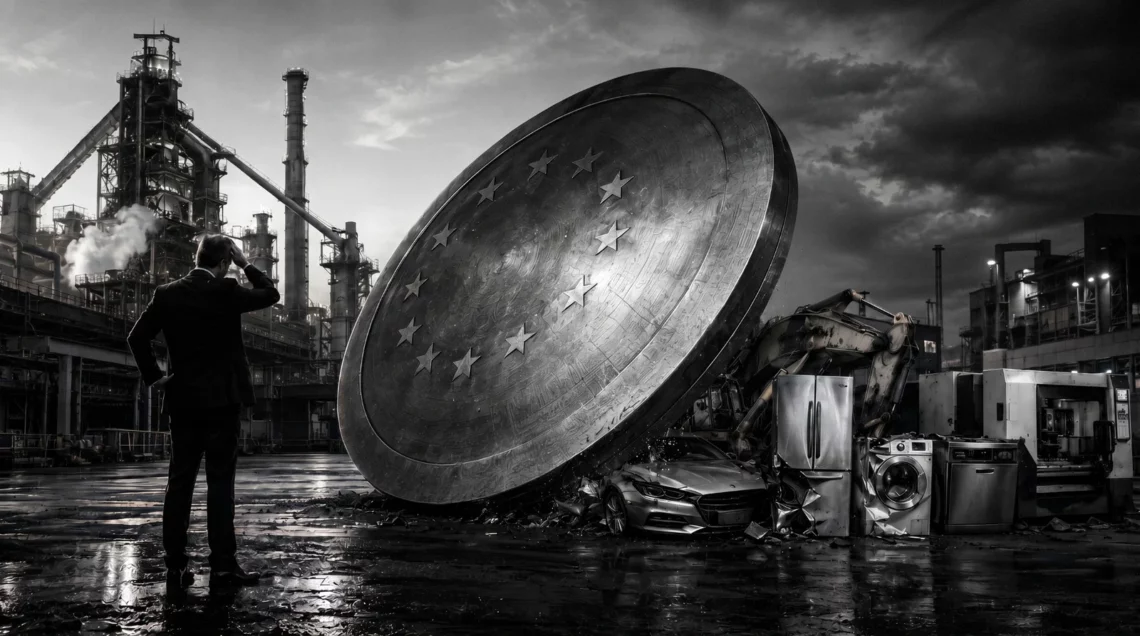
Steel Under Protection, Industry Under Pressure…
Since July 2026, the European Union has applied a new regulatory framework designed to protect its steel market from the effects of global overcapacity.
The new rules reduce the annual volume of import tariff quotas by approximately 47% — to 18.3 million tonnes — and introduce a 50% duty on deliveries exceeding the available limits. The measure covers 30 categories of steel products and significantly strengthens the existing protection of European producers against import pressure.
There is no doubt that such a solution is justified and needed. From the perspective of Europe’s economic security, it is a necessary direction — especially that European producers are under severe cost pressure resulting, among other things, from the need to carry out the expensive, overambitious energy transition programs required by EU regulations.
It should be remembered that Europe remains one of the most expensive regions in the world in terms of energy costs for industry, where electricity prices for businesses are more than 50% higher than in China.
Without concrete action, Europe would continue to lose steelmaking capacity and become increasingly dependent on steel imports. Europe, deprived of its own industrial base, would lose not only factories and jobs, but also its ability to respond independently in times of crisis.
Steel is not an ordinary commodity — it is a foundation of economic, energy and defence security.
This raises a fundamental question: what about the European companies that buy this steel?
Many of our readers will soon begin negotiations for fourth-quarter deliveries and know perfectly well that the tightening of tariff quotas will be repeatedly used as an argument during discussions with suppliers.
Restricting imports may improve the position of European steelmakers, but at the same time it means greater cost pressure for manufacturers that use steel as a primary raw material.
How can a European manufacturer remain competitive against companies from outside Europe that can produce the same product using significantly cheaper steel?
For comparison, the price of HRC in China is often below USD 450 per tonne.
Imported machinery, cars, components and household appliances are still not covered by a comparable level of protection. Competitive pressure will therefore not disappear — it may simply shift from the steel market to the market for finished products.
The European automotive sector is already learning this lesson the hard way, as it gradually loses a significant share of the market to Asian manufacturers.
Protecting the European steel industry without simultaneously safeguarding the competitiveness of steel-consuming sectors may therefore produce the opposite effect to the one intended: it may preserve some steelmaking capacity in Europe in short perspective while weakening the industry that is supposed to buy that steel in the longer one.
Without a strong customer base, even the best legislative support will not guarantee a secure future for steelmakers.
The fact that the Commission has begun to recognise the problem facing downstream industries is therefore encouraging. By 30 June 2027, it is expected to assess the possibility of extending protection to products made of steel or containing a significant amount of steel. At the same time, CBAM is expected to be extended to approximately 180 product categories with a high level of steel consumption.
The direction appears to be appropriate, but the effectiveness of these measures will depend on the range of products covered, the correct assignment of customs codes and the system’s resilience to circumvention.
In practice, creating an effective system will be an enormous challenge.
The risk of circumvention may include, among other things, attempts to change product classification through minor design modifications, declaring a lower steel content in a product, replacing components with non-steel materials, moving final assembly to third countries, or splitting a product into components covered by different CN codes.
The range of possibilities is vast, and the creativity of manufacturers and importers could put even the screenwriters of Mission: Impossible to shame — as has repeatedly been demonstrated whenever similar trade restrictions have been introduced.
Not to mention that the Commission plans these regulations to enter into force only in 2028, which, given today’s geopolitical realities and the extraordinary pace of change, looks less like caution and more like bureaucratic negligence as Europe continues to lose industrial capacity and market share at an alarming rate.
Even if the rules entered into force as planned, closing loopholes in the system and combating creative circumvention could take several more years.
The question therefore remains: does European industry have that much time?
There is one more element that cannot be ignored in this discussion: the risk of retaliatory measures by non-EU trading partners if protectionism continues to intensify.
Europe’s dependence on components manufactured outside its territory is so extensive that a single decision could paralyse supply chains across strategic European industries.
Is Europe prepared for that?
The discussion about protecting the steel industry should therefore form part of a much broader debate about the competitiveness of European industry as a whole.
Steelmakers need customers, and customers need steel at a price that allows them to compete in global markets. These two interests cannot be considered separately.
If Europe restricts access to cheaper raw materials, it should simultaneously create conditions that allow processing companies to remain competitive. Overambitious climate policies disconnected from economic realities, resulting in high energy costs, together with further regulations whose business rationale is — to put it mildly — questionable, certainly do not support that objective.
Without joint action by steelmakers, processors, manufacturers and the European Commission — with the project led by competent people who understand industrial realities — Europe may wake up too late, when its manufacturing base has become nothing more than a sweet memory.
Wake up, Europe! Before you wake up on a continent that knows how to regulate industry but no longer knows how to sustain it.
If you value analysis that looks beyond headlines and official statements, follow WBIZNES.COM. Here, industry is not an addition to the economy — it is its foundation.
#WakeUpEUrope #SaveEuropeanIndustry #WBIZNESCOM #CBAM #Quotas #Safeguards


You May Also Like

How not to shoot yourself in the foot?
The most important economic speech by Ursula von der Leyen in 2026? Almost unnoticed in Poland.