The most important economic speech by Ursula von der Leyen in 2026? Almost unnoticed in Poland.
Is Europe finally waking up?
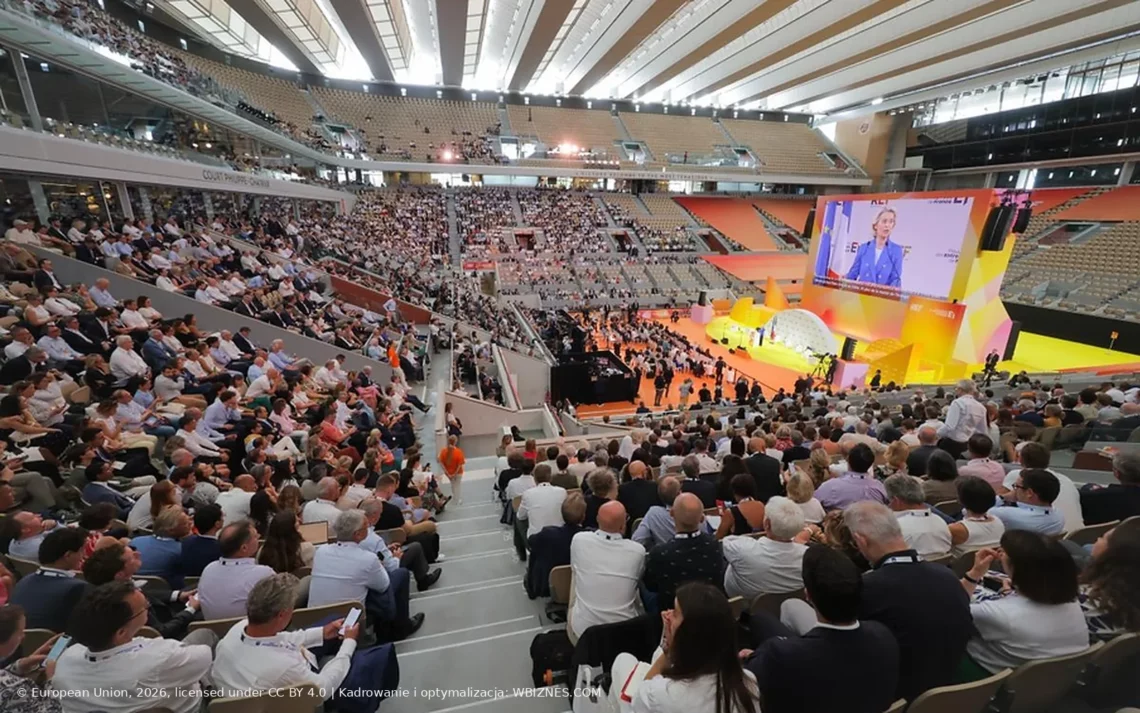
At the end of August, during La REF 2026 – one of the most important gatherings of French business and economic policy, organised by MEDEF at Roland-Garros in Paris – the President of the European Commission delivered a speech that went almost entirely unnoticed in the Polish media.
And that is a pity, because some of the statements made there may indicate that Ursula von der Leyen is finally beginning to recognise problems that many industry organisations have been warning about for years.
You cannot keep tightening regulation, increasing the cost of doing business, adding new procedures and obligations for industry, and still expect European companies to remain competitive to the United States, China and other economies operating under fundamentally different rules.
For years, Europe has lived under the illusion that it could be the world’s most heavily regulated economy, the most ambitious in climate policy and one of the most expensive places to produce and invest – while still preserving a strong industrial base and global competitiveness.
Reality is now exposing that illusion with increasing force.
That is why von der Leyen’s speech is worth reading in full. Not through the lens of isolated quotes or politically motivated commentary, but as a possible signal that Europe may finally be starting to rethink the way it approaches its economy, industry and competitiveness.
Perhaps Europe has not fully woken up yet. But for the first time in a long while, there are signs that it is beginning to realise just how badly it has overslept.
A link to the speech – and this one is genuinely worth reading in full:
Ladies and Gentlemen,
‘Victory belongs to the most tenacious’. This quote from Roland Garros that hangs above centre court – our host for today – encapsulates the spirit of entrepreneurship. You need even more of this perseverance in a world that has lost its certainties. And where the rules of the game have changed.
For a long time, the European economic model was based on a few obvious assumptions. Cheap imported energy. Open world trade. Growing access to the Chinese market. Strategic American protection. And Western technological progress. These have disappeared. What has also changed is that it has become more expensive to turn our advantages into investments, production and growth. Because your firms are facing several shocks at the same time. Higher energy prices. Fragmentation of the single market. Certain complex rules. And competition that is not always fair. That is why, in the short term, you need to be given back some space to invest. And, in the longer term, to make innovation, productivity and scaling-up the sustainable drivers of European growth.
Mario Draghi paved the way. And following in his footsteps, our aim is clear: to make Europe a continent that produces, invests and protects. To put industrial capacity back at the heart of our action. To create the openings that companies need to invest. And to make openness a source of strength based on reciprocity, fairness and the protection of our interests. France has had a major influence on these changes. On our need for independence. On industrial policy. On nuclear energy. On electrification. On artificial intelligence. All of this is France’s contribution. Europe is now making sure these choices have the necessary reach. Because none of these battles can be won by a single country. That is why we, as Europeans, must address all the factors that determine our competitiveness today.
Ladies and Gentlemen,
The first challenge concerns the rules and conditions for competition. European companies should not be paying twice: first because of overly complex rules and second because of competitors that do not have the same costs. We must therefore simplify and restore fair conditions for competition.
We will also be reviewing the whole body of EU law. Removing duplication. Reducing reporting obligations. Speeding up permitting. Designing simpler rules from the outset. And this effort will only be worthwhile if the Member States make a strong commitment against the infamous national gold-plating. We will succeed only if we all work together at all levels.
But this requirement for simplicity must go hand in hand with a requirement for fairness on the part of foreign competitors. This is particularly true in our relations with China. China is a key economic partner. And our approach is clear and consistent: derisking without breaking ties.
We must also defend the resources our economic security depends on: critical raw materials, batteries, semiconductors, cloud computing, data and sensitive technologies. Our market remains open. But openness requires security, fairness, and reciprocity, ladies and gentlemen.
The second challenge concerns the financing of our economies. In Europe, there is no shortage of technology or savings. But there is still a shortage of capacity to scale up Europe’s businesses. Too many projects stall because the initial investment is too risky, because demand is too uncertain or because capital is too expensive. Our companies know how to get started in Europe. But they also need to be able to grow here. Too often they go elsewhere for the funding they need. They shift their centre of gravity. Or they get bought out.
Of course, this isn’t something we will finance only from the public purse. But Europe has savings. And unfortunately, those savings are sitting idle. Today, EUR 10 trillion in household savings are kept in bank accounts. And a large share of Europe’s savings is invested outside our continent. Europe now needs to put these savings to work for its companies. This is the goal of the ‘savings and investment union’. We have tabled proposals on securitisation, on bank and insurance investments, and on the integration and supervision of our markets. Together, these measures could unlock up to EUR 470 billion in additional investment. We now need to reach an agreement, before the end of the year, ideally with all 27 Member States. But if that doesn’t work, if necessary we will do it with those that are ready.
Ladies and Gentlemen,
The EU budget also needs to scale up. The next budget will be the financing arm for our independence. With over EUR 450 billion from the European Competitiveness Fund and the Horizon Europe programme, we will support the entire chain. From research to innovation. From laboratories to business. And from initial prototypes to industrial production. Europe cannot set new targets unless it has the means to fund them.
The third challenge concerns the single market. It is our greatest economic asset. But it is incomplete for services, energy, telecommunications, finance and the digital economy. Internal barriers can have the same effect as customs tariffs as high as 45% on goods and 110% on services. We would never accept such tariff levels from a trading partner. And yet, we still accept them among ourselves in Europe. This is why we must finish the work that was started over 30 years ago. I would like to highlight one specific project: the ‘28th regime’ and ‘EU Inc’.
And there you have it: 30 years after Jacques Delors, that is how we will make good on the promise of the single market, ladies and gentlemen.
Our competition policy also needs to scale up. For the first time in over 20 years, we are conducting an in-depth review of our rules on mergers. The purpose being to take better account of investment, innovation, resilience and global competition, and enable our companies to grow in Europe and become global leaders. But scaling up requires more than just tailored rules; our companies also need markets and predictability. This is precisely the aim of the Industrial Accelerator Act. European preference. Faster permitting for industrial projects. Lead markets for steel, cement, aluminium, vehicles, batteries and clean technologies. And more strategic use of public procurement and State aid. And, dear Stéphane, this Act also carries your trademark: a Europe that invests more, but also produces more at home. That is what we need, ladies and gentlemen. Because when public funds are committed, they must serve our priorities: low-carbon production, the resilience of our value chains and that of European industry. In other words, giving our companies the confidence they need to invest in Europe. Industry invests when it sees a market. It is therefore up to us to give it that visibility.
Finally, the single market must also become a genuine skills market. Nearly two in every three SMEs have said they cannot find the skills they need. We must invest more in training and retraining. We must improve recognition of qualifications. And we must facilitate balanced and fair labour mobility. That is why, in the autumn, we will present a package on fair labour mobility. It will strengthen the European Labour Authority, propose a European Social Security Pass, and make it easier to recognise skills and qualifications throughout the EU.
The fourth challenge is energy. Nowadays, it is the main factor limiting our competitiveness and independence. Prices in Europe are still twice or three times higher than in the United States or China. And more than half of the energy that we use still comes from imported fossil fuels. This dependence is costly. Since the start of the crisis in the Middle East this dependence has already cost us over EUR 50 billion more. Without us receiving a single molecule of extra energy. For that reason, we must produce our own low-carbon energy in Europe.
So we must speed up the electrification of our industry, transport and buildings. That is the whole point of the Electrification Action Plan that we have just adopted. Because electrifying our economy means reducing our imports of fossil fuels and strengthening our independence.
But we cannot ask our businesses to switch to electricity when it is nearly three times more expensive than gas, on average. So we must bring down all components of electricity bills. First of all, through more long-term contracts. To protect businesses against volatility. And guarantee them a stable price over the long term.
This is unacceptable. So we must invest faster, speed up grid connections, develop storage and make better use of existing infrastructure. We have a lot of work ahead of us but we will do it. Because it is so urgent to do so.
Our approach is simple: a predictable carbon signal; better protection against carbon leakage; more support for those who invest and the time needed to transform our industry. We are not choosing between the climate and industry. We are turning the transition into the driving force for stronger European industry. Industry that invents here, produces here and captures the markets of the future. That is what we need here, ladies and gentlemen.
The fifth challenge is artificial intelligence. AI is an economic and technological battle. And it is one of the most powerful productivity levers that we have. Our strategy can be summed up in two words: produce and deploy. Produce, first of all. Europe must control the main elements: computing power, semi-conductors, cloud computing, data, energy and state-of-the art models. That is why we are mobilising EUR 20 billion for artificial intelligence gigafactories. The first call resulted in 77 proposals in 16 Member States, across 60 sites. What an impressive response! And we launched the second call this summer. And through the Cloud and AI Development Act and the Chips Act 2.0, we are strengthening the whole chain, from components to models.
Our businesses are already adopting AI at a similar pace to their American competitors. We now need to roll it out on a large scale. Europe has the industry. It has the researchers. It has the data. Now it must turn them into an economic advantage.
The sixth challenge is trade. In a more fragmented world, openness is a means of strength. Our trade agreements open up markets for our businesses. They diversify our supply chains. They secure the raw materials and components that we need. And they provide alternatives when certain partners become less predictable. That is what economic security means: never to be dependent on one player. Because an independent Europe is not an isolated Europe. It is a Europe that can choose. The CETA, our trade agreement with Canada, proves it. Since 2017, French exports of goods to Canada have increased by 45%,while French exports of services have more than doubled. This is what our trade agreements deliver. More opportunities for our businesses. Stronger value chains. And more freedom of action for Europe.
Ladies and Gentlemen,
To unleash it fully, tenacity will be needed. Yours. And ours.
Long live Europe. Thank you.
Source: European Commission Press Corner, Speech by President von der Leyen at the annual conference ‘La Rencontre des Entrepreneurs de France 2026’, Paris, 27 August 2026. © European Union, 2026, licensed under CC BY 4.0. Editorial formatting: WBIZNES.COM.


You May Also Like
India’s Economy – A Market European Companies Should Not Ignore
Alihankinta 2026. Do you have free production capacity in your steel business? It might be a good next step.