
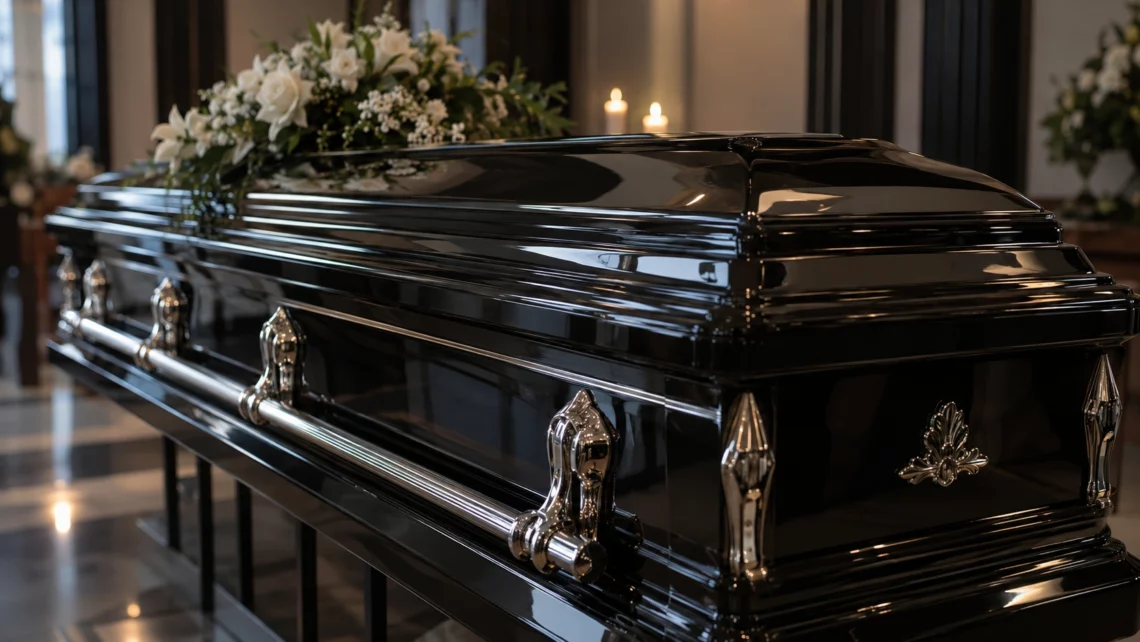
Dead serious business. Demand never dies here…
Dead serious business. Demand never dies here…
For centuries, economies have experienced ups and downs. Markets go through periods of prosperity, recession and crisis. Companies compete for customers, cut costs and seek new, innovative solutions. Nevertheless, there is one industry where demand does not depend on GDP growth, inflation or consumer confidence. An industry where customers cannot postpone their purchasing decisions until economic conditions improve. Without any doubt, funeral industry is the one in question.
All Saints’ Day is a time to remember those who have passed away. It is also an opportunity to take a closer look at an industry rarely discussed from a business perspective, even though it operates according to some of the principles common to other sectors of the economy. There are revenues, costs, profit margins, competition and the battle for market share.
How much is the worth of the business that never lacks customers? How much does the final journey cost in Poland, and who earns on it?
GUARANTEED CUSTOMERS – HOW MANY PEOPLE DIE IN POLAND AND EUROPE?
According to Statistics Poland (GUS), approximately 406 000 people died in Poland in 2025, which means an average of more than 1 100 deaths every day. The latest data for the first nine months of 2026 indicate approximately 305 000 deaths, which is 3 000 more than in the same period of the previous year. Considering the ongoing ageing of Polish society, further increases can be expected in the coming decades.
Across the European Union, the figures are even more striking. According to Eurostat 4.81 million people died in 2025. That is an average of more than 13 000 deaths per day. Behind each of these figures lies a human tragedy, but from an economic perspective, also the need to arrange a funeral.
Families may reduce their spending, give up additional services or choose less expensive funeral options. However, the necessity of arranging a final farewell remains independent from economic conditions.
And this is precisely where the funeral industry’s advantage lies. An economic crisis may reduce the value of an order, but it will not eliminate the fundamental need.
THE FINAL JOURNEY COMES WITH A PRICE TAG – HOW MUCH DOES A FUNERAL COST?
Since January 2026, the funeral allowance in Poland has amounted to PLN 7 000 (EUR 1 592.68), compared with PLN 4 000 (EUR 910.10), which was the amount paid by the government for the last 15 years. According to the state, the newly introduced amount should be sufficient to arrange a dignified funeral. Reality shows, however, that even after the increase, the allowance is not always enough to cover the costs of a final farewell.
According to industry reports from 2026, the total cost of a traditional funeral, even without particularly fancy arrangements, can range from PLN 8 000 (EUR 1 820.21) to PLN 16 500 (EUR 3 754.18).
However, some funerals are considerably much more expensive, with costs exceeding PLN 20 000 (EUR 4 550.52) and in documented cases reaching even as much as PLN 30 000 (EUR 6 825.78). It all depends on the location, the range of services, the family’s imagination and sometimes the final wishes of the deceased.
WHAT IS THE VALUE OF THE FUNERAL MARKET IN POLAND?
Taking into consideration even the basic cost of a funeral (PLN 8 000 / EUR 1 820.21) and the number of deaths in Poland, the market value can be estimated at over PLN 3 billion (EUR 682.58 million). But the findings presented above and the possibility that some services still remain in the grey economy (e.g. church services) clearly suggest that this figure could be significantly higher.
It is worth to remember here that these amounts are not collected exclusively by funeral homes. The supply chain also includes gravestone makers, florists, crematoria, coffin and urn manufacturers, transport companies, cemetery administrators and catering businesses providing services for funeral receptions – all these entities form a firm economic ecosystem associated with organising the final farewell.
NOT EVERYONE CAN ENTER THIS BUSINESS – COMPETITION AND BARRIERS TO ENTRY
Contrary to common beliefs, setting up a funeral company in Poland does not require any special permits, a licence or even ownership of any infrastructure. According to estimates presented by the Polish Funeral Association in 2024, approximately 2 500 – 2 800 funeral companies operated in Poland, of which only around 800 had their own funeral homes, cold storage facilities, special vehicles and employees. Among the remaining businesses, there were even single-person companies that relied mainly on outsourcing services.
However, this does not mean that there are no barriers to entry. Even with the possibility of outsourcing some services, this is a fairly hermetic market, where competition often can be fierce and effectively discourage new entrants. Local connection and long-standing, often well-funded relationships mean that a new company without established local ties may quickly be forced to close down.
One of the most notorious examples of such practices was the so-called “Skin Hunters” scandal revealed in Łódź in 2002, where ambulance workers received payments from funeral homes for passing on information about patients’ deaths and referring families to specific companies. In this case, the practice took a tragic, criminal turn – it resulted in final convictions of the murderers of five patients. This is an extreme example of just how fierce the battle for customers can become when profits are substantial.
One would like to believe that such practices no longer take place. Nevertheless, long standing connections among companies dominating local markets still remain one of the biggest barriers to entry in this industry.
FROM COFFINS TO CREMATORIA – HOW IS THE MARKET CHANGING?
Although the funeral industry is fairly conservative, changes are taking place here as well. Just a few decades ago, cremations accounted for only a small percentage of funerals. According to estimates by the industry representatives, their share in the Polish market now exceeds 40%. In large cities, this figure is even higher. For example, in Wrocław, during the first nine months of 2026, as many as 84.2% of burials at municipal cemeteries were urns.
The government has also noticed these changing trends. The Ministry of Development and Technology is preparing proposals for legislative changes that could allow, among other things, keeping urns containing ashes at home and scattering ashes outside cemeteries. Currently, such practices remain strictly prohibited. The proposals were scheduled for consideration on 27 October 2026, but no agreement was reached on all the proposed solutions.
Interestingly, there are already companies operating in Poland that offer jewellery or sole diamonds made using the ashes of deceased people. Although the legal grounds of such services raise questions, it seems that the creative approach of Polish companies has moved far ahead of the lawmakers already.
DEMOGRAPHICS DON’T LIE – ARE THE FUNERAL INDUSTRY’S BEST YEARS STILL TO COME?
While most entrepreneurs anxiously follow economic forecasts, the funeral industry remains calm. The demographic boom of the 1980s means that in a few decades, the industry will face significant growth. What will happen next? Judging by demographic trends, the boom will probably eventually fade. Fortunately, most of us won’t be worrying about it anymore. Once we’re dead, even the deepest recession won’t wake us up.
And although nothing in business is certain, one thing can be said here with absolute certainty – this industry will never run out of customers.

You May Also Like
GREEN STEAL – High-Risk Investments

One in five EU employees works remotely. Workation?