
One in five EU employees works remotely. Workation?
Since the pandemic, remote work has become a permanent part of working life across Europe.
A Eurofound report published on 21 July 2026 indicates that at least one in five employees in the European Union now takes advantage of the possibility to work remotely. It is worth noting, however, that the data cover everything from working outside the employer’s premises on a daily basis, through hybrid arrangements involving several remote days a week, to occasional days away from the office.
Beyond COVID-19, the main factors driving the growing popularity of remote work include among others employee preferences, the development of digital technologies, changing attitudes towards work and an increasingly competitive economic environment. Eurofound also points out that the widespread adoption of digital technologies and ICT (Information and Communication Technology) has been a key driving factor of flexible working models.
A new way of working also brings new challenges on both sides of the equation. The debate covers a wide range of issues, including employee productivity, clear rules on availability, working-time arrangements, the blurring boundaries between work and rest, and the risk of being permanently “on call”.
The report does not settle the question of whether “remote is better” or “the office wins”.
Ultimately, the most accurate answer would probably be: “it depends”.
It depends primarily on the organisation, the industry, the employee’s family circumstances, working conditions both at home and in the office, the nature of the role and responsibilities, and the employee’s level of autonomy. While many employees will appreciate the trust placed in them by their employer and greater autonomy may even strengthen their engagement – there will be certainly people on the other side of the spectrum for whom this model will have totally opposite effect.
This article, however, is not intended to determine who actually works when working from home and who has simply mastered the art of keeping the green dot active on Teams. As always, we will focus on the most important data and conclusions.
Remote work is on the rise in Poland. But the gap with Europe still persists.
In Poland, the share of employees working from home has increased noticeably in recent years. In 2015, it amounted only to 6%; by 2024, it had risen to around 12%. The progress is clear. However, over the same period, the EU-27 average increased from approximately 8% to 22%.
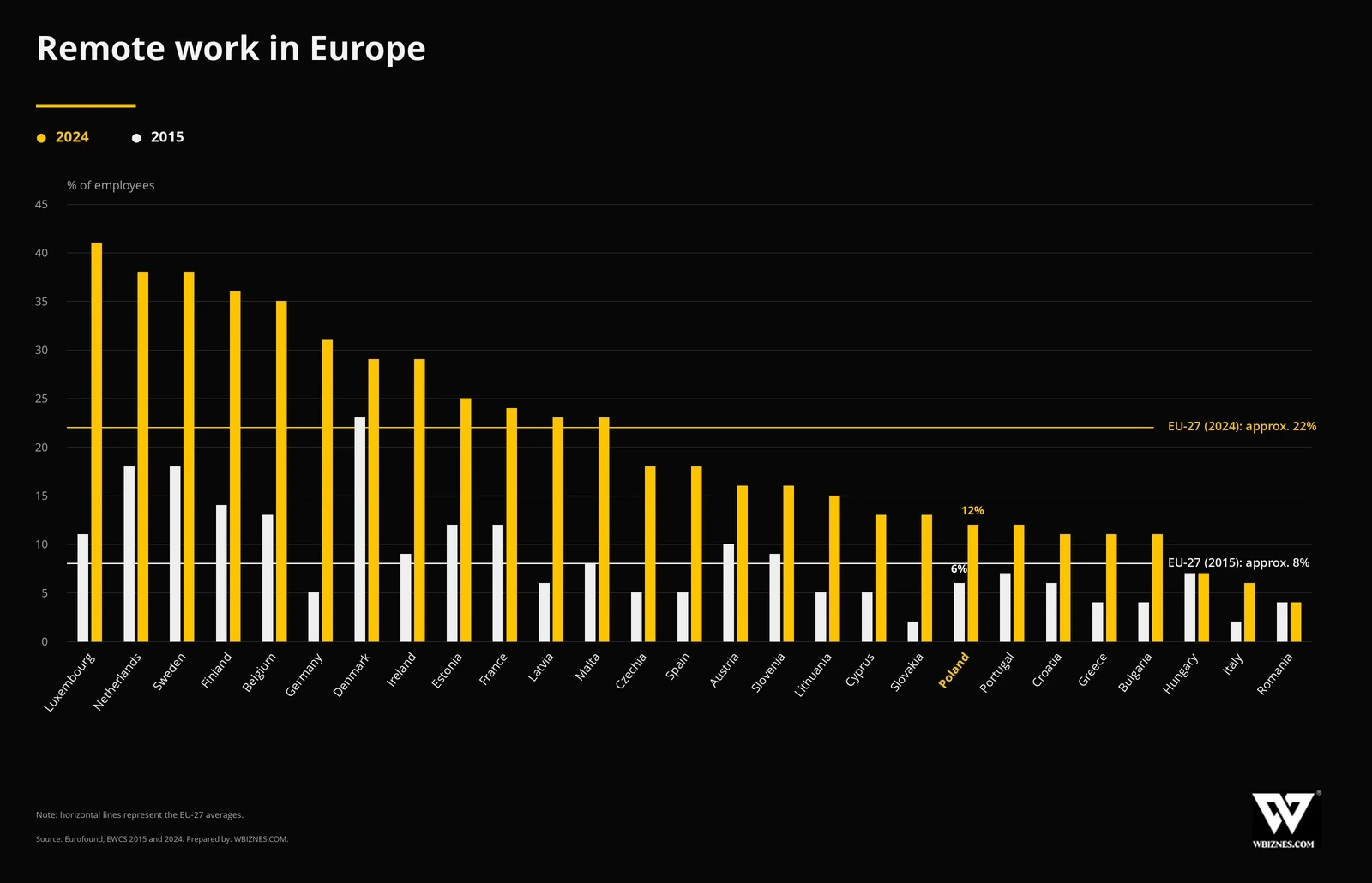
Poland is definitely not among Europe’s leaders in terms of remote work. However, when it comes to some factors affecting the quality of working outside the office, Poland was identified as one of the countries with the lowest occurrence rates across several problem areas.
Only 7% of employees in Poland reported unpredictable working hours, compared with an EU average of 14%. Work-related contact after working hours was reported by just 17% of employees, versus 21% across the European Union. Poland was also among the countries with relatively low levels of insufficient rest between working days — between 8% and 12%, compared with an EU average of 18% — as well as working during free time, reported by between 11% and 13% of employees versus an EU average of 16%.
The report’s biggest paradox
One of the report’s most striking findings is an apparent contradiction. Employees using flexible working arrangements are more likely to work beyond their agreed working hours, yet at the same time report better well-being and work-life balance.
According to the publication, they are also less likely to experience burnout and physical and mental exhaustion.
It appears, then, that an additional hour of work hurts a little less when it does not come with mandatory time spent at an office desk.
It is also worth to note that this may be partly linked to the absence of necessity to commute to work. The report clearly indicates that the expansion of remote work has delivered tangible benefits for employees in this respect. And let’s be honest our wellbeing is definitely highly challenged in the long traffic jams in big cities.
The atmosphere in the workplace may also be a significant factor. For some employees, the opportunity to limit their exposure to an unhealthy organisational culture may be just as valuable as eliminating the daily commute.
Remote work is evolving faster than legislation
Legislative bodies are attempting to keep pace with changes in the labour market. One of the key developments is so-called right to disconnect — the employee’s right to remain unavailable for work-related communication outside working hours.
Eurofound points out that frequent after-hours availability is among the main factors of higher stress level, greater mental strain and disruption to work-life balance.
By 2025, relevant regulations were already in place in 13 EU Member States. Poland was not listed among them, although the Polish National Labour Inspectorate points out that similar protection is indirectly provided by general rules governing working time and the right to rest.
Eurofound emphasises that remote-work regulations vary considerably between EU Member States, while detailed arrangements are often established at company level.
It also notes that some of the newer regulations simply fail to keep pace with the challenges created by fragmented working time and the increasingly blurred boundary between work and rest. There are many issues still requiring regulation. After all, being able to work with a laptop does not automatically mean being able to work anywhere in the world.
Employee mobility is developing much faster than the mobility of legislation, taxation and social security systems. A national border that an employee barely notices when logging into Teams remains very real for tax authorities and social security systems.
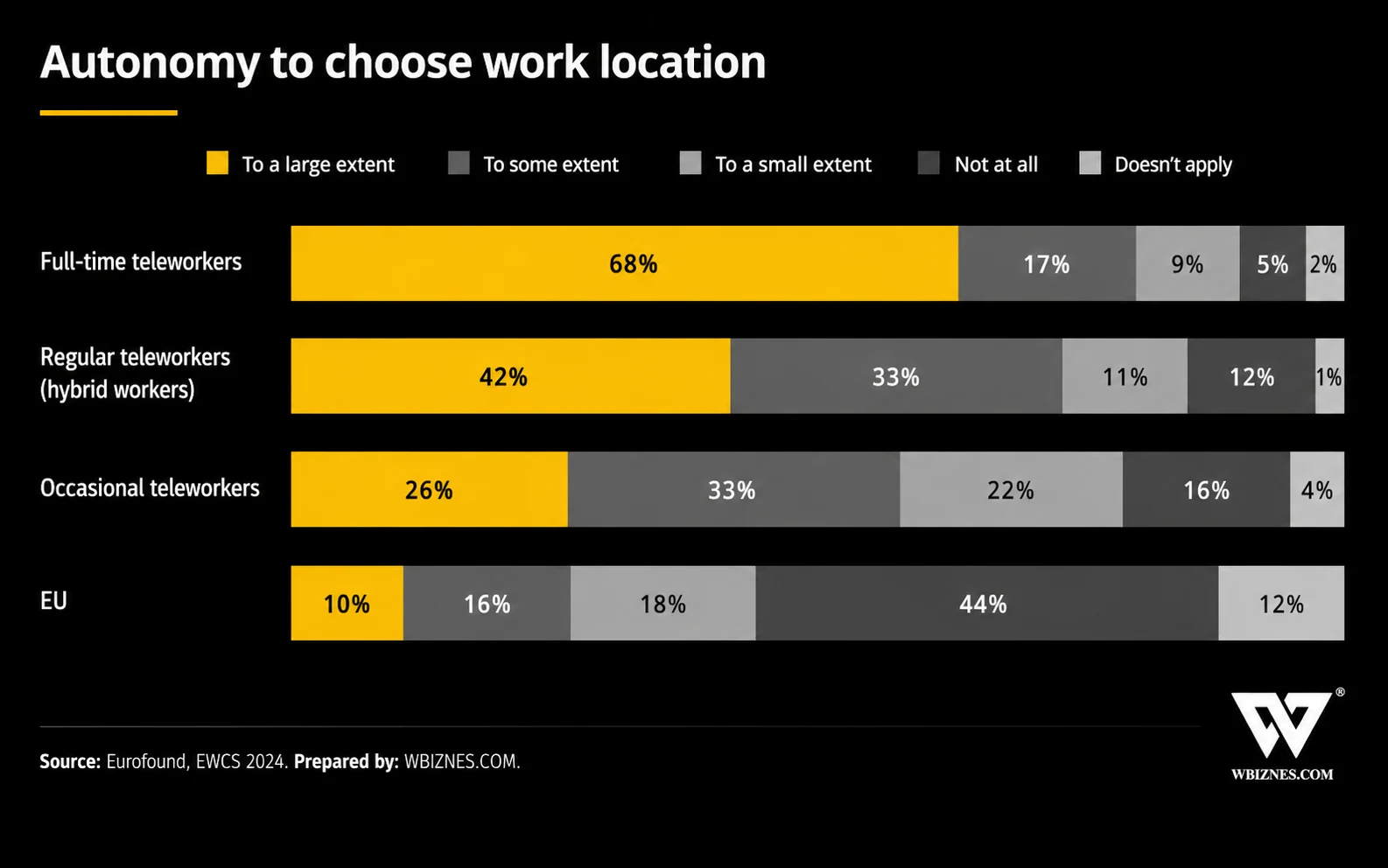
Despite this, there is a positive trend worth highlighting: as many as 10% of remote workers in the EU report a high degree of autonomy in choosing where they work.
Workation
One of the forms of remote work is workation — a combination of the words work and vacation.
This is not about taking a holiday with a company laptop on your knees. It is about performing standard professional duties from a location that, once the laptop is closed, offers significantly more opportunities to relax than a standard environment. After all, if many roles no longer require employees to be physically present at company premises every day, the place from which they work is itself beginning to become an important part of work-life balance.
The Polish city of Ełk has also recognised this trend and launched the “Ełk. Work. Lake. Life.” initiative. The city is developing a broad offer for remote workers from around the world, combining access to comfortable coworking spaces with the lake views, nature and urban infrastructure.
From tomorrow to Sunday, Ełk will host the Ełk Workation Festival — an event combining remote work, networking, physical activities and cultural events.
The full festival programme is available at:
https://www.workationfestival.elk.pl/program
Sounds like an ideal way to end the summer? Or perhaps you might decide to stay a little longer?
Report source:
Eurofound (2026), Working anytime, anywhere: The quality of working time in the EU, Publications Office of the European Union, Luxembourg.
https://eurofound.link/ef24032
#WBIZNESCOM #RemoteWork #Workation #ElkWorkation #ElkWorkLakeLife #LakeDesk #Ełk #EłkTuWracam #Masuria


You May Also Like

Where does your steel really come from? The EU will trace which furnace it was melted in.

GREEN STEAL – High-Risk Investments