

EUROFER: further revision for 2026, while the promised rebound has been officially postponed to 2027
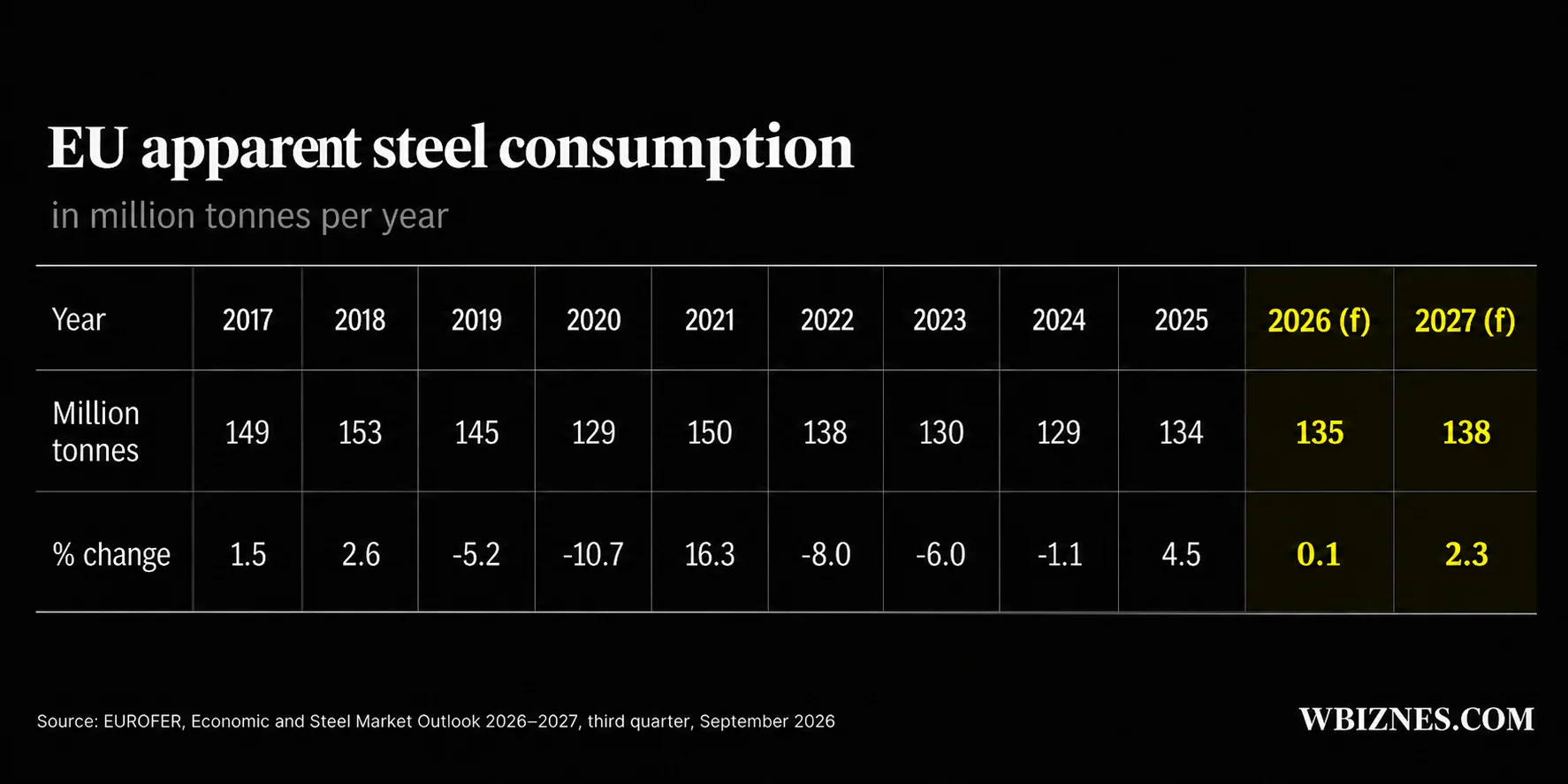
Back in the second quarter of 2025, EUROFER forecasted the apparent steel consumption in the European Union to increase by 3.4% in 2026. The expectation was then repeatedly revised down: to 3.1% in Q3 2025, 3.0% in Q4 2025, 1.3% in Q1 2026 and 0.4% in Q2 2026.
The latest Q3 report leaves just 0.1% of the previously expected rebound.
From +3.4% to +0.1% in just little more than a year.
It is hard to imagine a more illustrative example of the definition of the word “revision”.
Even though EUROFER has been forced to repeatedly correct its overly optimistic expectations for 2026, it still refuses to give up its strong belief in a rebound in 2027. EUROFER expects apparent steel consumption to grow by 2.3% in 2027.
FRAGILE FOUNDATIONS
Before we start believing in a rebound in 2027, it is worth to look at the foundations on which it is supposed to be built. In the first quarter of 2026, apparent steel consumption in the EU did increase by 1.5% y/y, yet EUROFER now expects full-year growth to amount to just 0.1%. This means that the demand momentum visible at the beginning of the year is expected to fade almost completely in the following quarters.
So what exactly is supposed to change next year?
It is worth to have a look at EUROFER’s forecast for activity in steel-consuming sectors, measured by SWIP (Steel Weighted Industrial Production Index):
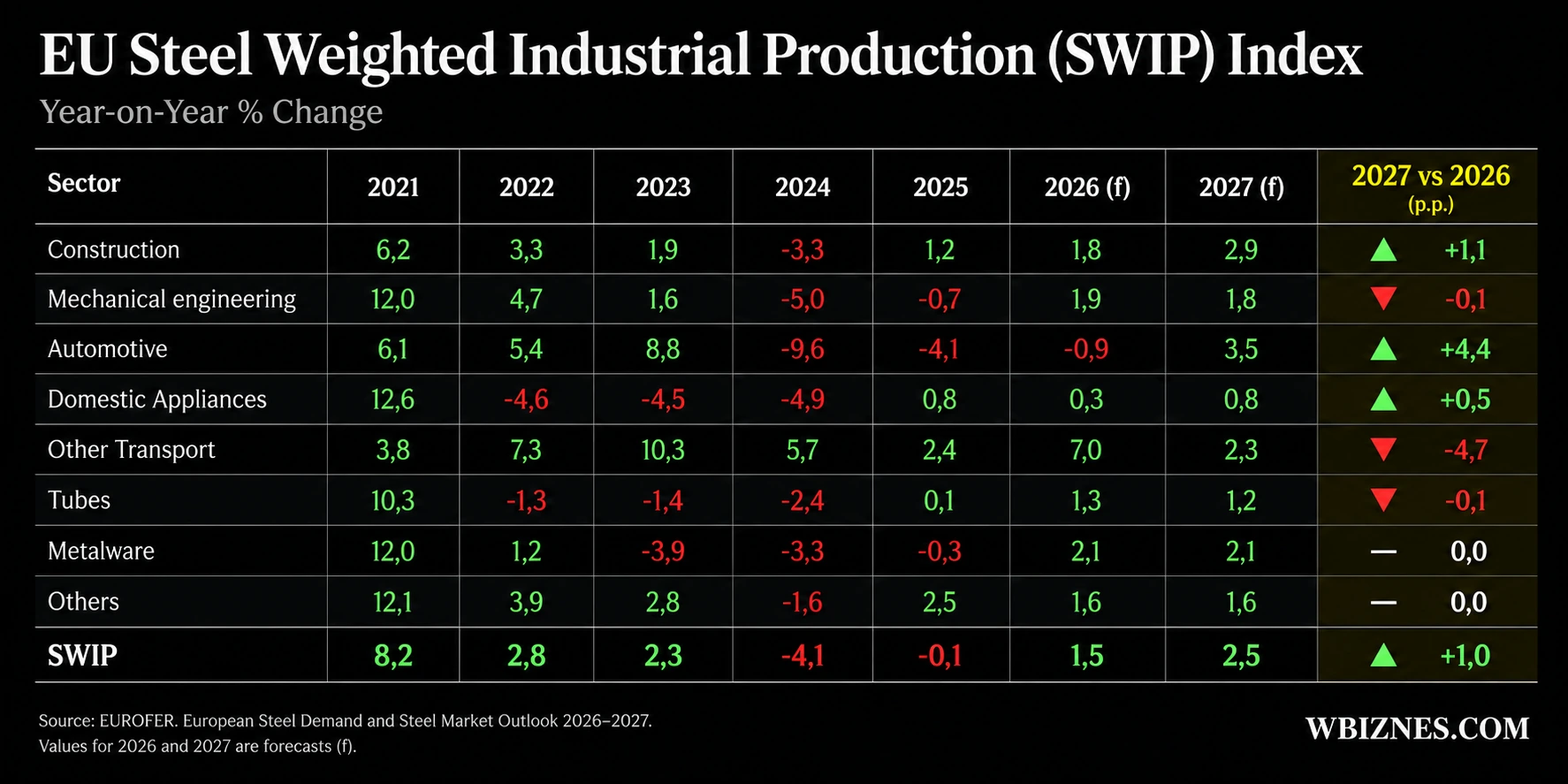
As shown in the table above, EUROFER identifies the automotive sector as the main driver of improvement in 2027. Following a forecast decline of 0.9% in 2026, sector output is expected to increase by 3.5% the following year, implying a total shift of as much as 4.4 percentage points – the largest among the main sectors included in the SWIP breakdown. But is this assumption sufficiently reflected in the current market reality?
As we wrote in our previous article, Volkswagen Group is already implementing restructuring programmes amounting to around 100 000 job cuts in total. Key suppliers to the European automotive industry are moving in a very similar direction. For example Bosch, which has recently announced further job cuts in its Mobility division (13 000 jobs) is just one of many examples of automotive-related companies forced to take the necessary steps to adjust to the current market.
On top of that, we have more and more worrying reports of car dealers’ inventories bursting at the seams across Europe, together with further expansion plans by the Chinese automotive industry in this part of the world. In view of just those few factors, the assumption that the European automotive sector will become the engine of the apparent steel consumption rebound in 2027 sounds more like wishful thinking than a scenario likely to materialise.
Sceptics – or, if you prefer, realists – may have similar doubts about the other sectors to which EUROFER assigns growth in 2027.
WEAKENING DEMAND
The concerns, however, are not limited to the internal market only. Axel Eggert, Director General of EUROFER, described the 20% y/y fall in EU steel exports in the first half of 2026 as an “alarming signal”.
And it is difficult to disagree – exports to the US fell by 29% y/y, to India by 24%, Turkey by 21%, China by 18%, the United Kingdom by 7% and Switzerland by 2%. This does not automatically mean that global steel demand has fallen by the same magnitude, since export is also influenced by tariffs, the cost competitiveness of our “green Europe” and exchange rates.
What it does show, however, is something equally important – European producers are finding it increasingly difficult to offset weak domestic demand with sales to countries outside the EU. If sales opportunities are shrinking both in Europe and outside it, the market has to adjust by reducing production output and putting greater pressure on pricing strategies. It is difficult to regard such an economic environment as a particularly strong foundation for the expected rebound in the European steel market in 2027.
FORECASTS SAY ONE THING, THE MARKET ANOTHER
Perhaps EUROFER is right and 2027 might indeed bring a stronger rebound.
For now, however, it is difficult to avoid the impression that 2027 has been given an unusually large amount of confidence credit in this report. We will therefore have to wait and see whether reality catches up with the forecast this time, or whether another revision appears in a few months.
And if anyone is still hungry for more forecasting magic, in our previous article we looked at another report from the “wishful thinking” series – this time concerning economic sentiment and employment expectations in the EU.
Link below:
https://wbiznes.com/nastroje-gospodarcze-ue/
Follow our social media profiles to stay up to date with our latest analyses, reports and the most important market developments.


You May Also Like

Number of Firearms in Poland: The Civilian Arsenal Has Already Exceeded One Million Units
U. S. Steel Košice disappears from the steel industry map