

Economic sentiment in the EU weakens. Employment expectations follow.
Economic sentiment and employment expectations weaken in the EU.
Anyone who naively expected the European economy to finally accelerate after the summer may want to postpone those expectations at least until next year. After several months of improving trend, the European Commission’s September Business and Consumer Survey may cool down some of the optimism surrounding the final months of the year.
In the final month of summer, the Economic Sentiment Indicator (ESI) in the European Union rose to 98.2 points, while the Employment Expectations Indicator (EEI) increased to 99.0 points. Both indicators therefore moved closer to their long-term average of 100. September, however, brought several months of moderate optimism to an end. The latest report from DG ECFIN (the Directorate-General for Economic and Financial Affairs) points to a decline in both overall economic sentiment and employment expectations. In September, the ESI stood at 97.9 points, while the EEI fell to 98.3 points. Although current levels remain well above historical lows, one can only hope that September’s reading does not mark the beginning of a deeper downward trend in the EU.
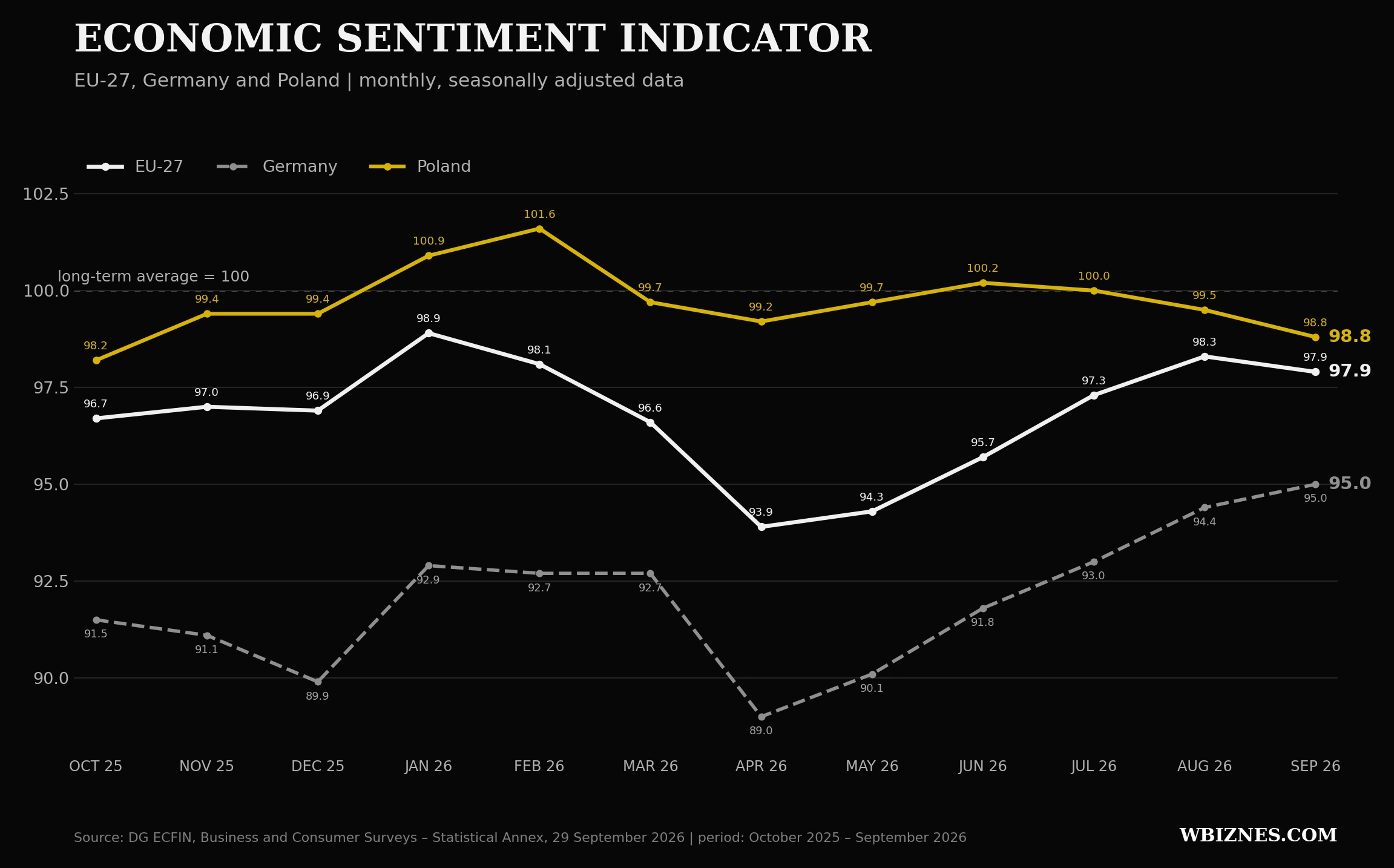
It is worth to notice that Germany clearly stands out here. Its ESI rose from 94.4 to 95.0 points in September, continuing the improvement observed since the April low. However, when the other responses from German survey participants are taken into account, the discrepancies between individual indicators become difficult to ignore and call for caution before declaring a long-lasting German recovery.
Consumers are not buying the optimism
Households remain one of the main factors dragging the indicators down. In September, consumer confidence in the EU fell by 0.8 points to -15.8, moving away from its long-term average again after four months of improvement. In the euro area, the decline was even greater – down 1.0 point to -16.5.
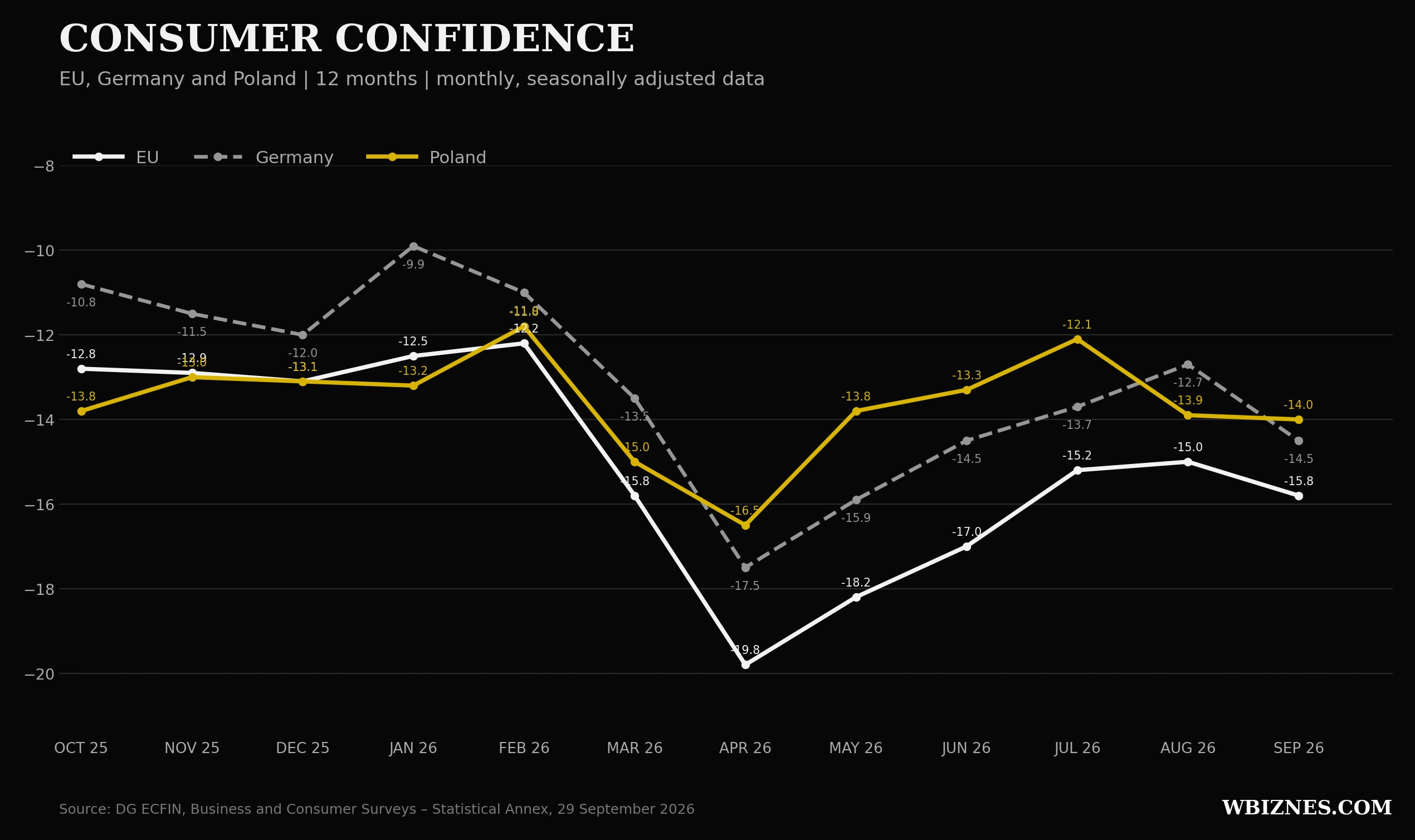
This also affects the industrial outlook. Weaker consumer sentiment does not automatically mean lower production, but more cautious households also tend to take a more cautious approach to major purchases. And without final demand, improving business expectations may take a long time to translate into a genuine economic recovery.
Industrial optimism or just another managerial attempt to buy time?
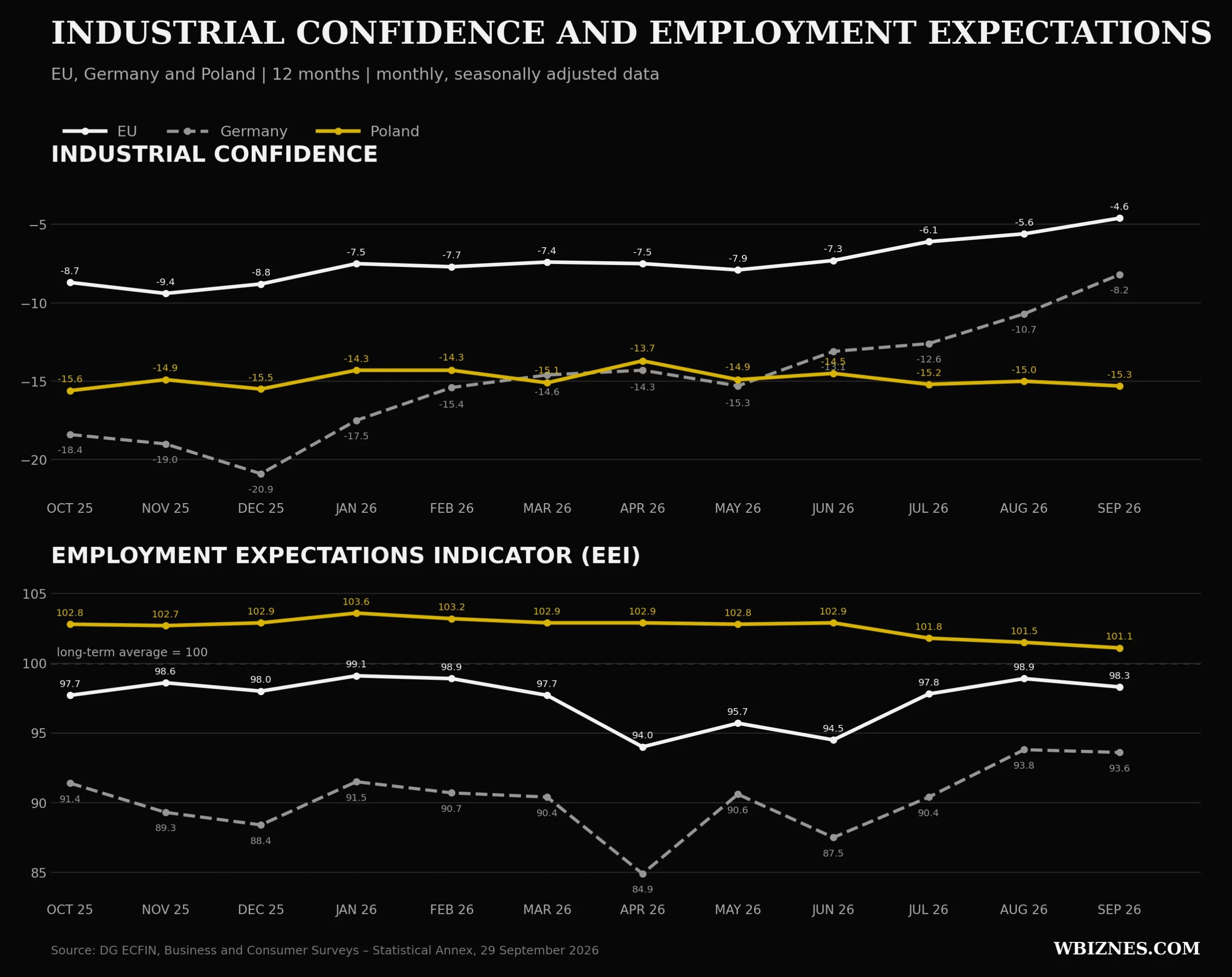
The September report contains more positive signals from the German market. Managers assess their order books more favourably and are clearly more optimistic about production in the coming months. In theory, this is good news – business surveys are forward-looking by nature, and companies may spot a change before it becomes visible in hard production data.
The question is whether this improvement in sentiment really reflects an approaching recovery, or whether expectations are once again bending reality – giving managers a few months of apparent relief from investor pressure.
Employment data should be the main warning sign. If companies were genuinely preparing for a stronger rebound in activity, one of the natural consequences should be a greater willingness to hire. Yet the overall Employment Expectations Indicator also deteriorated in September. Of course, the EEI covers not only industry, but also services, retail and construction, so it is not a direct measure of employment in factories. It does show, however, that the optimism expressed by industry has not yet translated into better employment expectations across the wider economy.
A similar question mark should appear over stocks of finished products. Their sharp increase may indicate that manufactured goods are not finding buyers quickly enough.
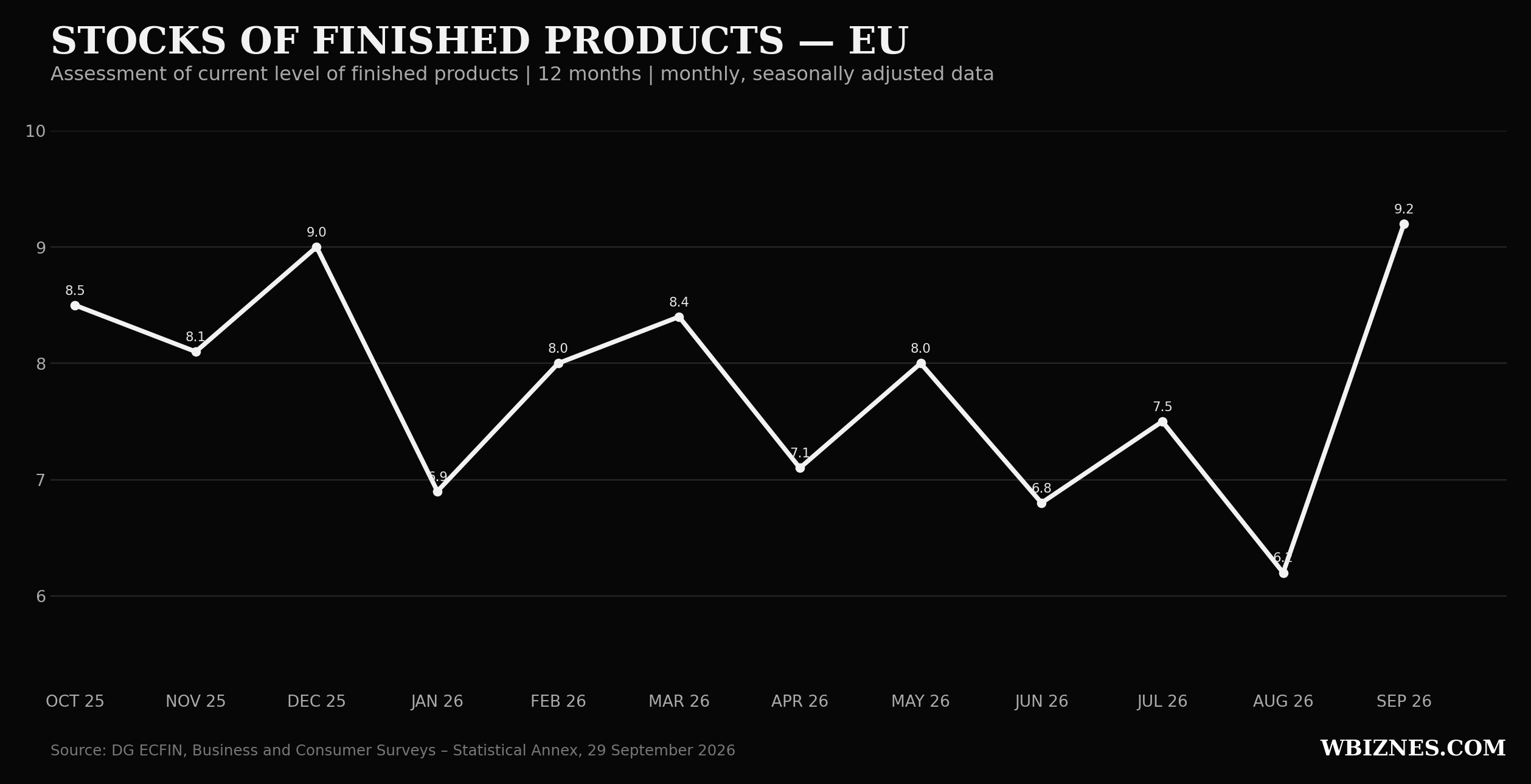
In such an environment, more optimistic production forecasts look considerably less convincing and appear more like an attempt to sustain the recovery narrative than a confirmation of a genuine industrial rebound.
Will this sentiment translate into real economic performance?
One thing is certain – Europe’s engine needs another diagnosis.
For now, the signals coming from Germany – Europe’s industrial engine – remain exceptionally mixed. On the one hand, management teams are trying to create a desirable picture by forecasting a clear improvement in sentiment. On the other hand, decisions taken by some of Germany’s largest corporations tell a very different story. Volkswagen Group is carrying out restructuring programmes affecting a total of around 100 000 positions, Thyssenkrupp Steel Europe plans to cut around 11 000 jobs – approximately 4 000 of which have already been cut – while Bosch intends to reduce around 13 000 positions in its automotive business by the end of the decade.
If things are going so well, why are they going so badly?



You May Also Like

Will the Middle East do more for electromobility in Europe than Brussels has done in years?

EUROFER: further revision for 2026, while the promised rebound has been officially postponed to 2027