

Moody’s gets moody. Poland downgraded.
Moody’s gets moody.
Poland downgraded
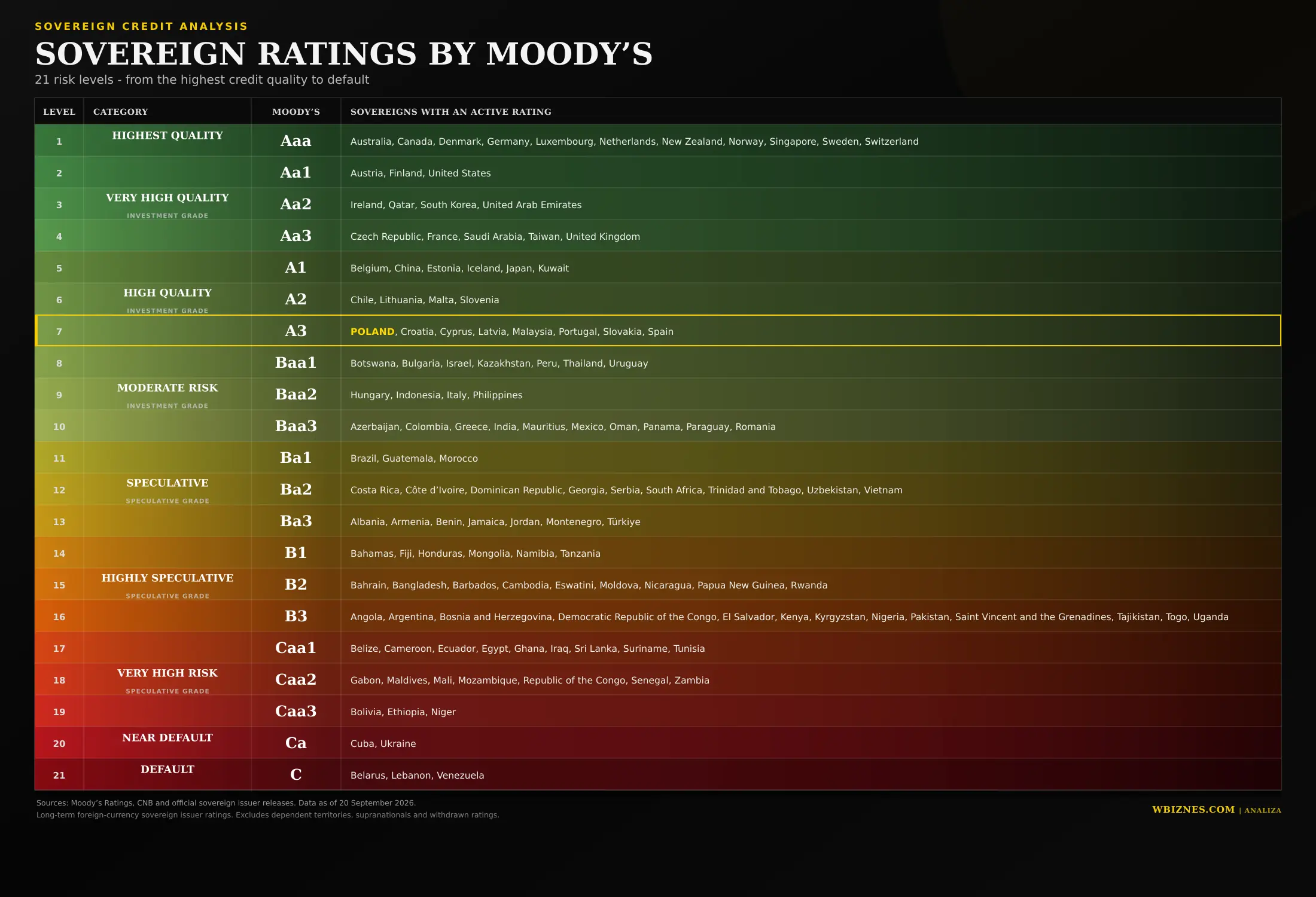
For the first time in 31 years, Moody’s has downgraded Poland’s credit rating. On 18 September 2026, the agency lowered the country’s long-term credit rating from A2 to A3 (7th level on the 21-grade scale). Moody’s stated that the weakening of Poland’s public finances is structural in nature and that the country failed to use the period of strong economic growth to rebuild its fiscal buffers.
Poland’s rating history with Moody’s
1995 – Moody’s begins rating Poland: Baa3
1995-1999 – Baa3 maintained
1999 – upgrade from Baa3 to Baa1
1999-2002 – Baa1 maintained
2002 – upgrade from Baa1 to A2
2002-2026 – A2 maintained, with periodic changes to the outlook
2026 – first downgrade: from A2 to A3, stable outlook
Moody’s rating scale
Moody’s?
Moody’s is an American financial and analytics group founded by John Moody. Its founder was an American financial analyst, entrepreneur and investor who began providing investors with analysis as early as 1900 through the publication “Moody’s Manual of Industrial and Corporation Securities”. In 1909, he introduced letter-based risk ratings for US railroad bonds, laying the foundations for the modern credit rating market. Today, Moody’s Ratings, together with Fitch Ratings and S&P Global Ratings, is one of the world’s three leading credit rating agencies.
A credit rating is an assessment of an issuer’s ability and willingness to repay its obligations on time. In the case of a sovereign state, the agency analyses among other things, the pace of economic growth, the condition of public finances, the level and structure of debt, debt-servicing costs, the quality of institutions, the stability of the system and political risks. In the simplest terms, a sovereign rating works in a similar way to the creditworthiness assessment of a person applying for a mortgage – it determines the debtor’s credibility and the risk that obligations will not be repaid on time – with the difference that the entity being analysed is a state and its financial credibility is assessed by an “independent” rating agency. Ratings are used by banks, funds, insurers and other investors. Some institutions, for example, are subject to statutory or regulatory restrictions on investing in financial instruments with ratings below a certain level.
What is the problem?
The agency pointed out persistently high deficits, rising public debt, increasing interest costs and weaker fiscal policy effectiveness. According to Moody’s, the general government deficit is expected to amount to around 7% of GDP in both 2026 and 2027, despite strong economic growth.
Debt calculated according to the EU methodology is expected to rise from 59.7% of GDP in 2025 to 68.9% of GDP in 2027. The agency cites high defence spending, healthcare, public investment and social commitments. It also notes that an increasing share of new debt is being accumulated outside the scope of the domestic debt rule.
And this is where we reach a point that cannot simply be covered up by another press conference: the problem is not only that the state is spending a lot. The problem is also that part of the debt has been moved outside the most visible measure, while the bill will still ultimately be paid by the taxpayer.
Moody’s also highlights continuing conflict between the government and the president, which, together with the approaching parliamentary elections, limits the ability to bring public finances under control. It is therefore worth remembering that our domestic disputes do not end when the cameras are switched off or when the latest social media post disappears from the feed. They are analysed by agencies and investors around the world. The world is not assessing who won the latest press conference, but whether the state is capable of making decisions and keeping its finances under control.
CONSEQUENCES
The rating downgrade does not mean a financial catastrophe. Poland remains investment grade, but the downgrade may increase the cost of government financing, weaken confidence among some investors and, in periods of heightened tension, put pressure on the Polish currency PLN. The sovereign rating is also a benchmark for banks and companies. More expensive public debt may, over time, translate into higher interest rates on loans and corporate bonds. A single downgrade does not overturn an economy, but it reduces the safety margin before another one.
Taking into account the approaching election year, rising business costs and repeated warnings from the prime minister about an approaching war, the rating downgrade may further weaken Poland’s attractiveness in the eyes of investors. As Moody’s analysis clearly shows, Poland failed to use the period of strong economic growth to put its public finances in order. Likewise, we did not fully use the years of cost advantage to build our own products, technologies and global brands. If costs and risks continue to rise, some corporations may choose to locate new investments or move production to cheaper countries in the region, such as Romania. Poland is still supported by its highly skilled and creative workforce, because lower wages alone do not guarantee an advantage – shortages of specialists in cheaper locations often force companies to recruit abroad, ultimately increasing production costs. However, caution is required, and we should remember that capital has no sentiment – if it came in search of lower costs, it can also leave in search of lower costs.
CHALLENGES
The real challenge is not recovering one letter in Moody’s rating table. It is recovering the ability to inform citizens that not every promise can be financed, not every expense is an investment and not every debt disappears simply because it has been moved outside the budget. It is also worth considering greater support for local companies which, despite excellent ideas and potential, often lack sufficient capital to expand their operations on a larger scale. As a result, they face a choice between limiting further development and selling part or all of their business to a foreign investor. If we want to build a strong economy, we cannot stop at attracting foreign corporations – we must also create conditions in which Polish companies can remain independent, develop their own products and become global brands. Unless Poland’s development strategy is to continue being based on the priorities of foreign capital rather than on building our own?
Moody’s gets moody. We can smile at the title. Whether that smile remains after looking at the numbers – that is an individual matter.
Sources:
Ministry of Finance, “Historical changes in Poland’s credit rating” and the announcement of 18 September 2026.
https://ratings.moodys.com/ratings-news/473201

You May Also Like

GREEN STEAL – High-Risk Investments

Alihankinta 2026. Do you have free production capacity in your steel business? It might be a good next step.