
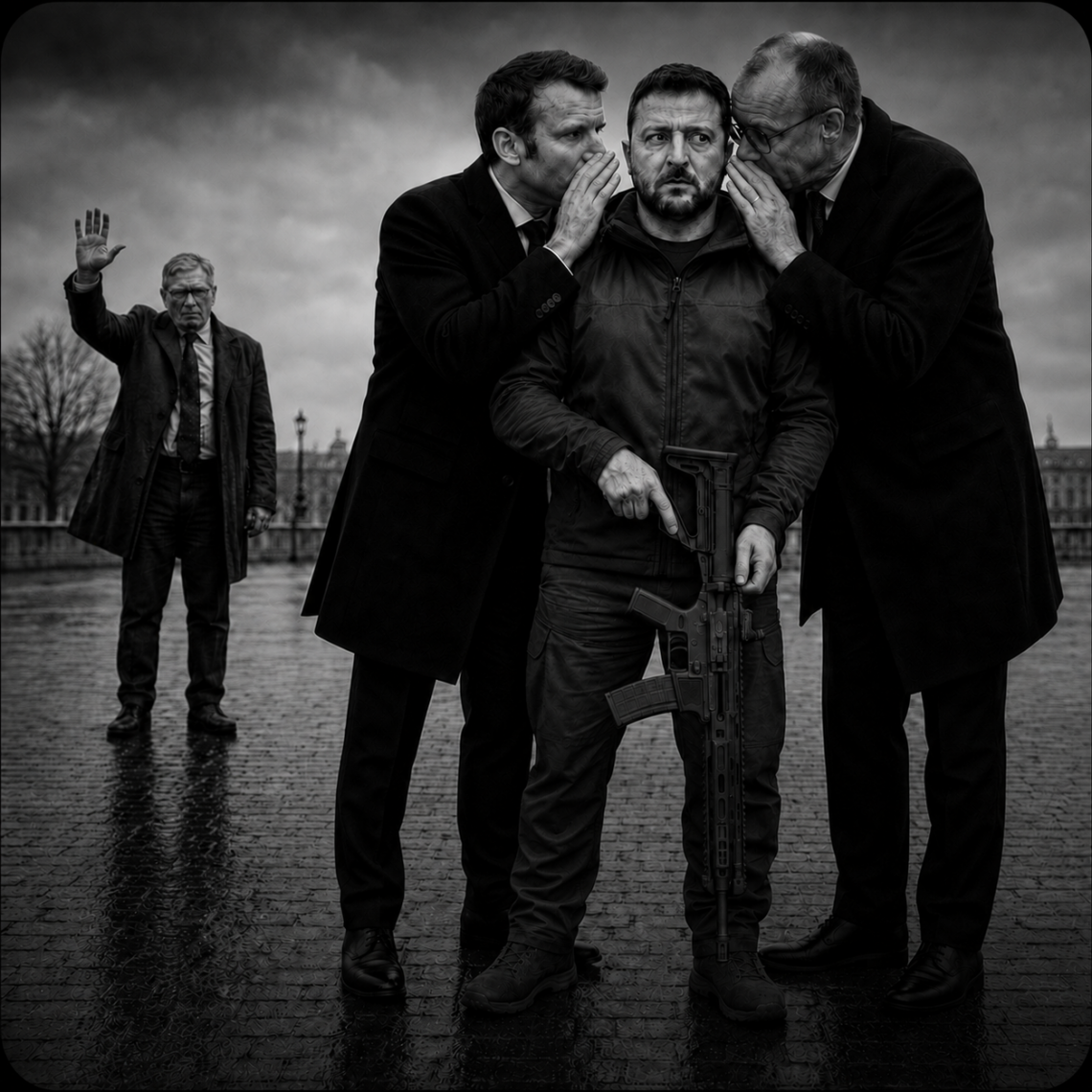
How not to shoot yourself in the foot?
Some decisions appear strong, decisive and effective in the moment. Only later does it become clear that their real cost was far greater than the short-term effect they were meant to deliver.
This article is not a historical analysis, nor is it an attempt to settle political disputes. It is a reflection on something that applies just as much to business: communication, partnership, trust, symbols and the consequences of decisions made under pressure.
Because in politics, just like in business, you can win one move and still weaken your long-term position.
1. Do not confuse strength with arrogance
In times of conflict, symbols matter enormously. They can build morale, strengthen identity, mobilise society and send a signal of determination. The problem begins when a symbol that is meant to express strength to one audience is perceived by another as a disregard for historical memory, sensitivity or mutual respect.
The decision to use symbolism connected with the UPA may have been intended as a message to a specific audience. From the perspective of strategic communication, however, the key issue is not only which group this gesture was meant to mobilise or reassure, but also how it could be received by partners whose support and trust remain strategically important.
This becomes especially relevant when the other side is a close partner, an ally or a group whose support has real strategic value. In Poland, the subject of the UPA is not a distant historical footnote or a matter of symbolic convenience. For many people, it is connected with real tragedy, family memory and unresolved pain.
A leader’s strength is not only measured by the ability to make a powerful gesture. True strength also lies in the ability to anticipate its consequences.
Business works in a very similar way.
There is nothing wrong with being a tough negotiator. You can firmly defend your price, margin, payment terms, scope of responsibility, delivery deadlines or the interests of your company. But toughness should never turn into humiliation of the other side.
Sometimes you can win one point and lose the relationship.
And relationships with customers, suppliers, investors, business partners, teams or strategic allies are often built over many years. One poorly judged communication decision can destroy trust that may later be needed during the next project, complaint, supply chain crisis, market shift or difficult conversation about money.
Professional strength is not about provocation. It is about control.
A good leader and a good negotiator can be firm without being arrogant. They can defend their interests without closing the door to future dialogue. They can send a strong signal, but only after assessing how that signal will be received by the other side.
In negotiations, communication and business leadership, it is worth remembering one principle: not every display of strength improves your position. Sometimes it only reveals a lack of self-control, sensitivity and strategic thinking.
2. Partnership is tested by how you treat those closest to you
Since the beginning of the full-scale invasion, Poland has been Ukraine’s most committed ally in Europe. Military, logistical, humanitarian and political support, the reception of millions of refugees, social solidarity and diplomatic action — this support came not only from institutions, but also from the heart of Polish society.
It was a real commitment by the state, society and economy.
That is precisely why the decision to name a Ukrainian unit after the “Heroes of the UPA” was received in Poland with profound dismay. It was not only about the name itself. It was about the signal sent to one of Ukraine’s closest allies.
If someone supported you through your most difficult moment, the way you later respond to their sensitivities reveals the true quality of that partnership.
In politics, such gestures carry significant weight. They will not, by themselves, bring an entire strategic relationship to an end — Poland and Ukraine still cooperate in many areas. But even the strongest partnership can be weakened when one side begins to feel that its loyalty, effort and sacrifices have been exploited rather than respected.
Business works in exactly the same way.
A company, a leader or an owner is not truly judged by their approach to new customers at the beginning of a relationship. They are judged by how they treat those who have been with them the longest: loyal customers, key suppliers, employees, partners and investors.
You can talk about values, partnership, long-term cooperation and future growth. But the real test comes when there is a conflict of interests, a complaint, a crisis, a required concession or a difficult decision to make.
At that moment, it is worth asking a few simple questions:
Do you remember who helped you when things were difficult?
Do you respect those who helped build your business over the years?
Are you treating your partner’s loyalty as weakness?
Are you assuming that “they will stay anyway”, so they can be ignored?
This is one of the most common mistakes in business. Companies often put more effort into winning new customers than taking care of the ones who have funded their growth for years. Leaders sometimes spend more attention on external image than on the people who deliver results every day.
Buyers can squeeze strategic suppliers so hard that they damage the very relationships needed to maintain supply continuity. Salespeople can promise miracles to a new customer while neglecting those who have already trusted the company.
And then a crisis arrives.
Suddenly, the partner who had been close for years no longer wants to help. The supplier no longer gives priority to your orders. The customer does not forgive the delay. The employee stops going beyond the minimum. The market no longer believes your declarations. The business environment stops seeing the company as a reliable player.
Partnership does not end when the contract is signed. That is when its real test begins.
Your closest partners must not feel used, ignored or taken for granted. How you treat those closest to you is exactly how others judge what kind of partner you will be to them.
In business, a reputation as a good partner is not built through sales presentations. It is built through consistent behaviour and reactions in difficult situations.
And the most revealing test of partnership is how you behave when you are in a position of strength.
3. Do not trade long-term position for short-term advantage
In politics, short-term effect can be very tempting. But the real question is: what comes next?
The decision to name a unit after the “Heroes of the UPA” may have served a short-term political purpose. It may have been intended as a signal to domestic society, the military and groups expecting strong national symbols.
But politics does not end with one message. Just as business does not end with one transaction.
Today, you can score points with one audience. Tomorrow, you may have to return to the table with partners who understood that gesture very differently.
This is especially important when strategic partners are involved. Poland has been one of Ukraine’s most committed allies in Europe. Its military, logistical, humanitarian, social and political support had real value.
That is why the question is not only: “Did this gesture pay off today?” The real question is: “What price might this gesture carry tomorrow?”
Because the war will eventually end. Governments, public moods, budget priorities, political arrangements and economic interests will change. Today’s leaders may not hold the same position in a few years. Some may leave office. Others may no longer be able to run again. Others will have to respond to pressure from voters, business communities and coalition partners.
And then very concrete questions will return:
Who will influence future aid packages?
Who will vote on the next stages of European integration?
Who will train Ukrainian soldiers?
Who will open or restrict access to markets?
How will potential partners assess a state that sends ambiguous signals to its closest allies?
In international relations, signals like this do not disappear without consequence. Partners begin to ask themselves: what happens when another player appears and offers more — politically, economically or strategically?
If one of the closest allies was treated this way, what guarantee is there that the same mechanism will not be used against us in the future?
Partners do not look only at what you say to them today. They also look at how you treated others yesterday.
Business works in exactly the same way.
Today, you can win a price negotiation, pressure a supplier, exploit a customer’s weak position, delay payment, force a concession or show your team “who is in charge”. For a while, you may even look like the winner.
The numbers in Excel improve. The margin goes up. The board sees savings. The ego gets its reward.
But business does not end with the next quarter.
If a supplier remembers that you treated them instrumentally, they will not prioritise you in a crisis. If a customer feels that you took advantage of their weaker position, they will not invite you to the next project. If employees see that loyalty does not matter, they will stop giving more than the minimum.
If the market concludes that you change the rules whenever a better opportunity appears, your reputation will start working against you.
The greatest mistake of a short-sighted leader is confusing a temporary result with a strategic victory.
In negotiations, communication and business leadership, you need to think not only about what can be gained today. You also need to think about who you will have to talk to tomorrow, next year and five years from now.
Because partners remember.
They remember whether you were loyal when you had the advantage.
They remember whether you respected their interests when you did not have to.
They remember whether you treated the relationship as shared capital or as a tool for one-time use.
That is why short-term gain can become extremely expensive. Especially when the price is the loss of trust.
And trust is a currency that cannot be rebuilt with one press release, one meeting or one presentation. It is built over years. Sometimes it is lost in a single move.
Follow WBIZNES.COM — more practical inspiration, insights and analysis on negotiations, communication and strategic thinking are coming soon.
WBIZNES.COM

You May Also Like

Layoffs Hidden from the Statistics. Why Isn’t Unemployment Rising Despite a Wave of Alarming Reports?
25 July 2026
The most important economic speech by Ursula von der Leyen in 2026? Almost unnoticed in Poland.
7 September 2026