
Will the Middle East do more for electromobility in Europe than Brussels has done in years?
Will the Middle East do more for electromobility in Europe than Brussels has done in years?
For years, Brussels tried to persuade Europeans to switch to electric cars by offering substantial subsidies, introducing increasingly stringent CO2 emission limits and announcing a complete end of the combustion cars registration by 2035. National and local authorities added their own packages of incentives: electric cars could use bus lanes, benefit from free parking in the centres of some cities and, in designated locations, even charge at no cost.
Despite all these measures, the argument that may truly accelerate electromobility did not come from Brussels. It appeared on fuel stations’ price boards.
Escalation of the conflict in the Middle East
The escalation of the conflict in the Middle East caused major disruptions in the fuel market. On 27 February 2026, Brent crude oil cost USD 72.48 per barrel. Two months later, its price reached even USD 126.41 per barrel – the highest level since March 2022 (an increase of more than 74%).
The surge in oil prices quickly translated into higher petrol and diesel prices. According to an INDICATA analysis, fuel prices in several European markets increased by at least 17% within a few weeks, and in some cases by more than 30%.
Geopolitics therefore did what no European information campaign had managed to do in the past – it immediately turned pragmatic drivers’ attention to electric cars.
How much does it cost to drive 100 kilometres?
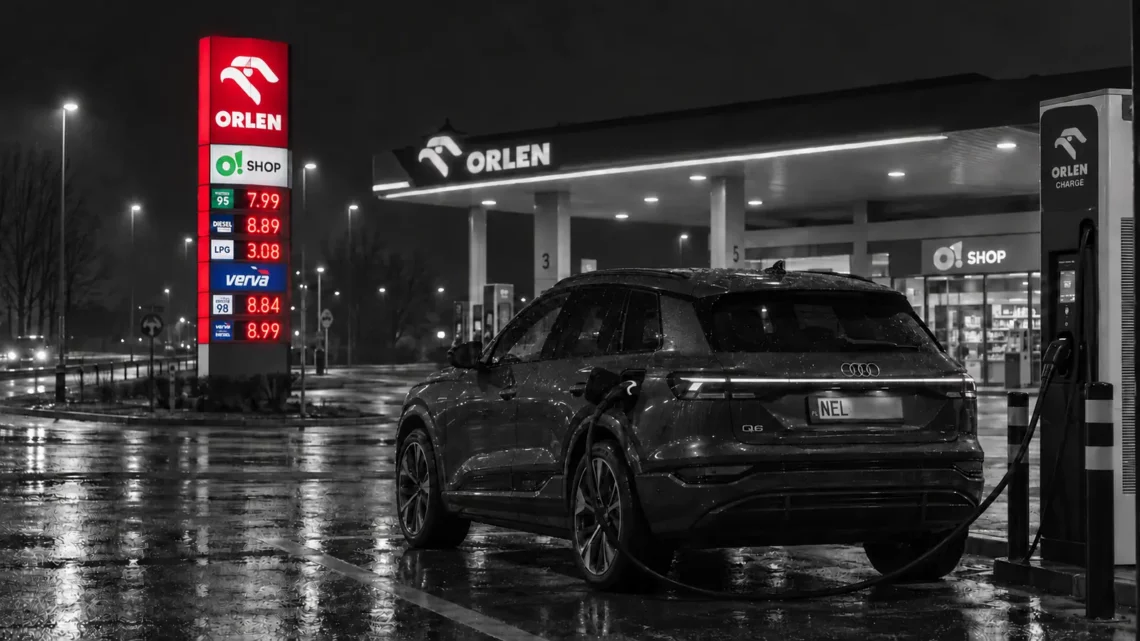
Last week, a litre of Pb95 petrol cost on average PLN 7.99 (EUR 1.84), diesel PLN 8.89 (EUR 2.05), and LPG PLN 3.08 (EUR 0.71). These are average nationwide retail prices published by e-petrol (updated on 16 September 2026). EUR equivalents were calculated using the National Bank of Poland average exchange rate published on 16 September 2026: EUR 1 = PLN 4.3435. AC and DC charging rates come directly from the official ORLEN Charge price list and do not include fees for overstaying. For home charging, an indicative average electricity cost under the G11 tariff (including distribution charges) was assumed. The comparison below is based on the average fuel consumption of the Audi Q5 TFSI S tronic (150 kW) and Audi Q5 TDI S tronic (150 kW), as well as the energy consumption of the Audi Q6 e-tron. For the LPG variant, a hypothetical conversion of the Audi Q5 TFSI was assumed (with LPG consumption 20% higher than petrol consumption and a 5% petrol co-injection). The indicative cost comparison based on Audi WLTP data, average fuel prices and electricity rates is presented below:
| Powertrain | Consumption per 100 km | Price | Cost per 100 km |
|---|---|---|---|
| Petrol | 6.9 l | PLN 7.99/l (EUR 1.84/l) | PLN 55.13 (EUR 12.69) |
| Diesel | 6.35 l | PLN 8.89/l (EUR 2.05/l) | PLN 56.45 (EUR 13.00) |
| LPG | 8.28 l LPG + 0.345 l petrol | PLN 3.08/l LPG (EUR 0.71/l) + PLN 7.99/l petrol (EUR 1.84/l) | PLN 28.26 (EUR 6.51) |
| EV – home | 18.3 kWh | PLN 1.04/kWh (EUR 0.24/kWh) | PLN 19.03 (EUR 4.38) |
| EV – public AC | 18.3 kWh | PLN 1.95/kWh (EUR 0.45/kWh) | PLN 35.69 (EUR 8.22) |
| EV – public DC | 18.3 kWh | PLN 2.69/kWh (EUR 0.62/kWh) | PLN 49.23 (EUR 11.33) |
The result leaves no room for doubt and is unlikely to escape drivers’ attention. A home-charged electric car can travel 100 km for approximately PLN 19 (EUR 4.37). That is nearly 66% less than the petrol variant included in the comparison and almost 33% less than the LPG variant, which until recently was regarded as the most economical way to power a car.
The difference becomes even more striking as annual mileage increases. At 20 000 km per year, the cost of energy for a home-charged electric car would amount to approximately PLN 3 800 (EUR 874.87). For a petrol car, it would exceed PLN 11 000 (EUR 2,532.52). That represents PLN 7 200 (EUR 1,657.65) in annual savings – an amount for which most drivers could probably find a more reasonable use than leaving it at a fuel station.
The picture changes completely depending on where the vehicle is charged. When using a public AC charger, the cost of driving 100 km immediately rises to approximately PLN 35.69 (EUR 8.22). Together with a necessary pause of 5 to 10 hours to recharge the battery it may discourage even the most committed electric-car enthusiasts. Fast DC chargers significantly reduce this time, but the cost of driving 100 km then increases to approximately PLN 49.23 (EUR 11.33). At this level of expenditure, the savings compared with a petrol car becomes so modest that, for many drivers, it may not justify the risks and limitations associated with using an electric vehicle.
For drivers who can charge their car at home and do not make long-distance journeys, this difference in costs may be a sufficient argument for choosing an electric car. Those with their own renewable energy systems, either at home or at their workplace, may find electric cars even more attractive, as charging costs can be reduced further and, in some cases even close to zero.
Interest in electric vehicles is growing
An important signal comes from incoming orders placed with German manufacturers. According to the German Association of the Automotive Industry (VDA), the number of domestic orders for battery-electric vehicles (BEVs) increased by 62% year on year in August, while since the beginning of 2026 it has been 64% higher than in the corresponding period of 2025.
Interesting conclusions also emerge from data on new passenger car registrations including all brands in Germany. In August, 68 930 battery electric cars were registered – 75% more than a year earlier. BEVs accounted for 32.4% of all new registrations. This was the second-highest monthly share of full battery electric cars in the history of the German market after the record set in December 2022, when the share reached 33.2% before subsidies were reduced.
Interest in plug-in hybrids is also growing. In August, 25 406 cars were registered – 6% more than a year earlier. Together, BEVs and PHEVs accounted for more than 44% of all new cars registered in Germany. This was the highest share since Germany’s Umweltbonus was reduced at the end of 2022 and the second-highest result in history.
Source: VDA report published on 3 September 2026
Demand and conclusions
If high fuel prices will stay will us for a longer time (and everything seems like they will), the Middle East may, within a few months, do more for electromobility than all the European policies have done in recent years. This is not because regulations haven’t worked. They forced manufacturers to expand their model ranges and the market to build infrastructure. However, only economic calculation may persuade drivers to make greater use of the available alternatives. Many Europeans remain sceptical of the EU’s “green” policy, but in the face of the geopolitical situation, they are paying increasingly close attention to their own finances.
Could this effect actually work in European governments’ favour? Since high fuel prices increase the economic attractiveness of electric cars and justify the utopian narrative of a “Green Europe” as well as generate enormous revenues for public budgets – there may be limited motivation to deal with it firmly. Just beyond the European Union’s eastern border, a litre of 95 octane petrol costs approximately PLN 3.41 (EUR 0.79), which is almost 57% less than in Poland. This does not prove the existence of deliberate action, but it shows that the price at the pump does not depend solely on oil prices.
Follow us on social media.


You May Also Like
Alihankinta 2026. Do you have free production capacity in your steel business? It might be a good next step.

Layoffs Hidden from the Statistics. Why Isn’t Unemployment Rising Despite a Wave of Alarming Reports?