

Layoffs Hidden from the Statistics. Why Isn’t Unemployment Rising Despite a Wave of Alarming Reports?
Almost every day, we hear reports of further layoffs, restructuring programmes and factory closures. Green circles are appearing increasingly often around the profile pictures of people in our professional networks — a discreet yet public signal that other, usually effective, job-search methods have failed. Meanwhile, Poland’s official unemployment rate has barely changed and remains among the lowest in the European Union. What explains this discrepancy?
To explain this obvious paradox, three separate events must be distinguished: the announcement of job cuts, the actual loss of employment, and the point at which an unemployed person appears in official statistics. These events may be separated by weeks or even months. Sometimes the third never occurs at all — even though the person is literally unemployed.
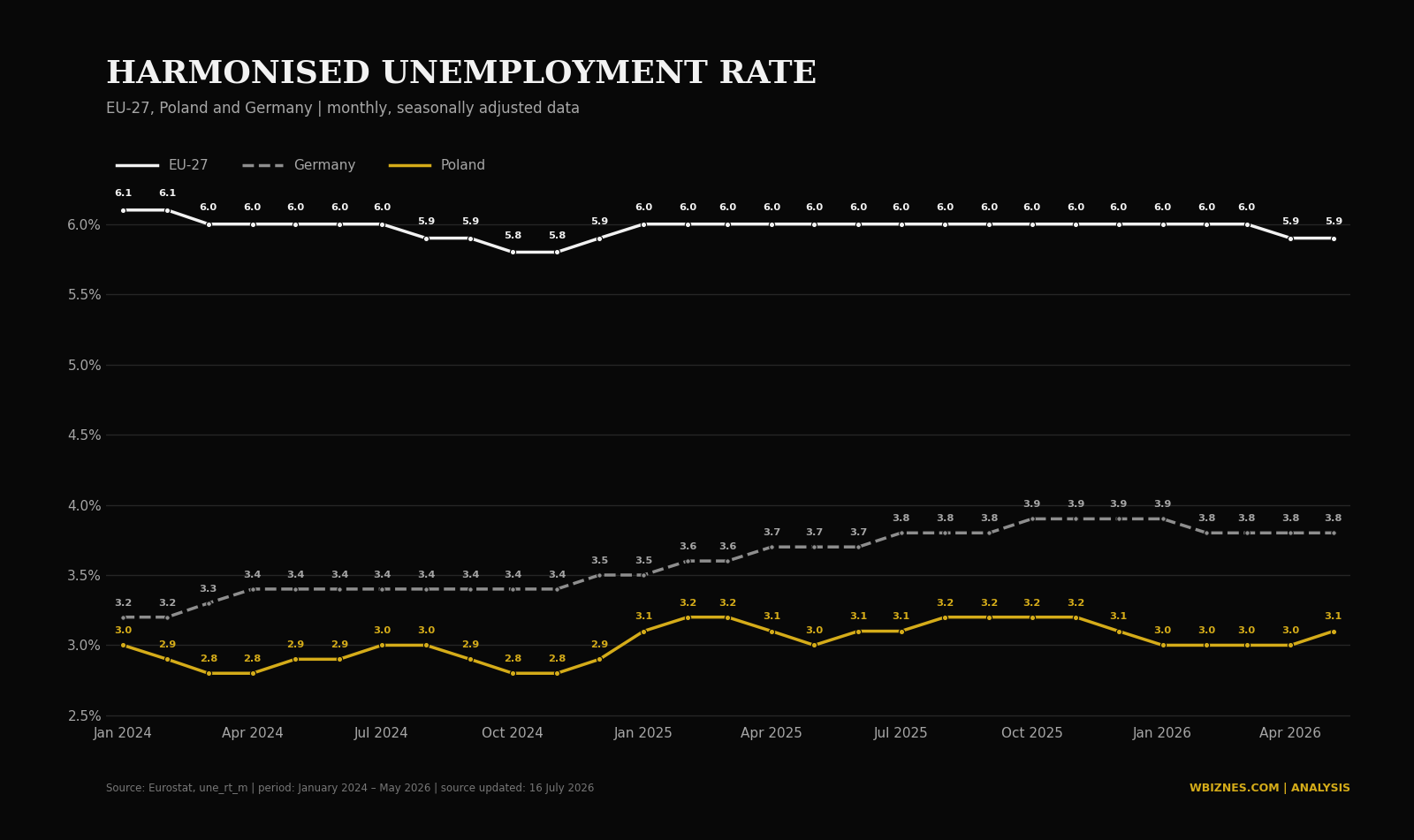
According to the latest available Eurostat data, the harmonised unemployment rate in May 2026 stood at 5.9% in the European Union, 3.8% in Germany and 3.1% in Poland. A year earlier, the respective figures were 6.0%, 3.7% and 3.0%. The headline data therefore show no wave of unemployment corresponding to the volume of concerning news coming from companies. On the contrary, after fifteen months of stability, the harmonised unemployment rate in the European Union has even begun to decline.
When a company announces collective redundancies, the employees affected do not become unemployed on the same day. Consultations take place first, followed by the first notices of termination and the beginning of transition periods. Some employees use this time to find another job, negotiate favourable severance terms or take sick leave.
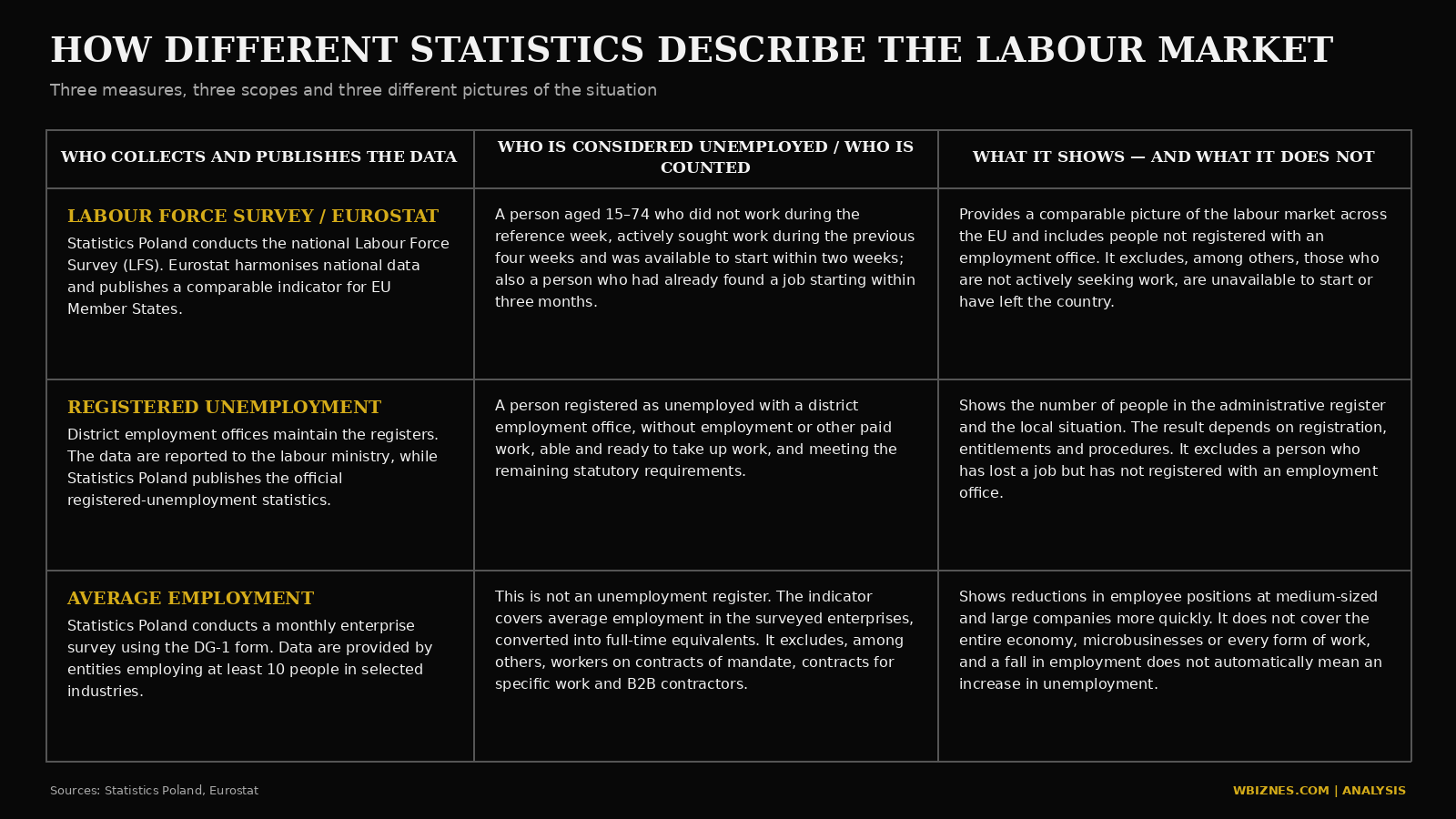
Only after their employment has ended, some of them — unless they decide to travel around the world for a while — register with a public employment office or begin to fit the definition of an unemployed person used in statistical surveys. The entire process may take several months. Moreover, there is no single, universal definition of an “unemployed person” — it depends on who produces the statistics and how they are compiled:
Many people will therefore never appear in the statistics, even though they consider themselves unemployed or are genuinely experiencing the effects of a deteriorating labour market.
All the indicators described above show only part of the picture. Changes in the labour market may appear in unemployment statistics with a significant delay — or may never appear in them at all. Before companies begin formal redundancy procedures, they typically freeze recruitment, allow fixed-term contracts to expire, reduce overtime and cut the number of hours worked by both permanent and agency workers.
An agency worker who previously worked full-time and regularly received overtime may be offered only a few hours of work per month, yet still not be classified as unemployed for a considerable period. In addition, the formal structure of agency employment may make it difficult to capture the true scale of reductions at a particular plant or across an industry. Many agency workers come to Poland for seasonal employment. After losing their jobs, they may simply leave the country, meaning they will appear neither in Polish unemployment registers nor in subsequent surveys of the domestic labour market.
New regulations strengthening Poland’s National Labour Inspectorate have also been in force since 8 July 2026. By means of an administrative decision, the Inspectorate may determine that an employment relationship exists where an agreement formally concluded as a contract of mandate, a contract for specific work or a B2B contract in practice meets all the criteria of employment. These include work performed personally and for remuneration, under supervision, and at a place and time specified by the employer.
The significance of these regulations can be clearly seen in the previously discussed indicator of average employment in the enterprise sector. Statistics Poland calculates this indicator partly on the basis of its monthly DG-1 survey. Average employment covers employees working under an employment relationship, converted into full-time equivalents. It does not include people working under contracts of mandate, contracts for specific work or B2B arrangements.
If an existing civil-law agreement or B2B contract is recognised as an employment relationship, a person performing exactly the same work may begin to be included in average employment figures. The indicator may therefore rise even though not a single new job has been created. What changes is the legal and statistical classification of existing employment, rather than the actual number of people performing work.
This is worth remembering, particularly ahead of the 2027 parliamentary elections, when a single indicator can easily become a political argument. A potential increase in average employment could be presented as evidence of an improving labour market, even though it may result, at least in part, from the administrative reclassification of existing contracts and could be used to obscure unfavourable economic conditions.
We are not suggesting that the Inspectorate’s new powers will necessarily be used in this way. We are, however, highlighting a mechanism that — particularly if inspections intensify — may affect the picture presented in official statistics. The impact of such decisions on business costs and competitiveness is a separate issue. WBIZNES.COM will examine it in a dedicated analysis.
Several hundred redundancies at a single factory may be a tragedy for employees and their families, a serious problem for the local community, and an important warning signal for an entire industry — while simultaneously providing attractive clickbait for the media. Yet such a decision may make very little difference to the nationwide unemployment rate. A series of layoffs becomes clearly visible in the statistics only when it continues for long enough, affects numerous companies and sectors and — most importantly — people losing their jobs stop finding new employment.
This does not mean that information coming from the market should be ignored. Europe’s economic situation is genuinely alarming and may deteriorate further, particularly if the European Union fails to take concrete action to strengthen the competitiveness of its economy. It is nevertheless important to maintain a sense of proportion and distinguish warning signals from evidence of a crisis affecting the entire labour market. Not every alarmist headline presents the full picture — sometimes it is simply good clickbait.
This is why WBIZNES.COM will focus on analysis based on data, facts and a comprehensive understanding of the context. We do not intend to ignore disturbing signals, but neither do we want to uncritically repeat messages whose primary purpose is to provoke an emotional response.
Would you like to look at business and the economy beyond the headlines? Follow WBIZNES.COM and subscribe to our publications on LinkedIn, Facebook, Instagram and X.